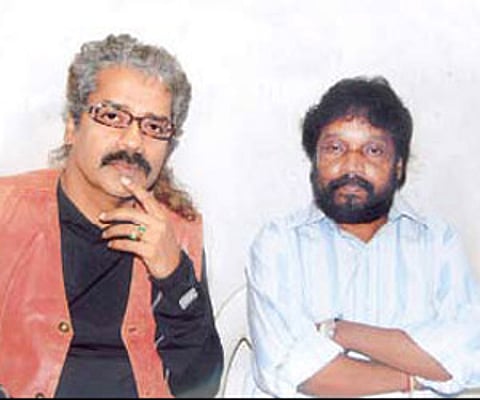

KOCHI: When Mohan Sitara was in his early twenties, he was working as an assistant for a well-known music director. Since he was a gifted musician, he showed his skills on the harmonium, the violin, the drums and the bongo. “I knew I was good at what I was doing,” says Sitara.
However, the music director, suffering from insecurity, suddenly told Sitara to leave. “He gave no explanation. I knew I had not done any wrong.” Sitara went to his room and started crying. He never worked again with the composer.
During this period, he went for a performance in Thrissur and met a glamourous singer, Chitra (name changed). She belonged to an affluent family and was drawn to Sitara because of his talent. But the composer belonged to a poor family in Thrissur. They fell in love. However, months later, when the news leaked out, the inevitable happened: the family took Chitra away. And he never saw her again.
That spelled three years of devastation for Sitara. “I was like a mad man,” he says.
“I would wander from place to place in torn shirt and trousers. I grew my hair and beard and started drinking heavily. Soon I ran out of money.” One rainy night, after a long drinking session, Sitara decided to kill himself.
He put poison into a glass of whisky. At 2 a m, as he was about to raise the glass to his lips, there was a knock on the door of his room at Thiruvananthapuram. He was surprised to have a visitor at that hour.
Quickly he slid the glass under the bed and opened the door. “It was my older brother Krishnan who had come all the way from Thrissur.” He told Sitara that the engagement of their younger sister, Ramani, had been fixed and the family needed some money.
“I was alarmed,” says Sitara. “Here I was trying to kill myself when the family was dependent on me to rescue them.” When his brother left, Mohan threw the whisky into the wash basin. “I understood that through Krishnan’s knock, God was saying he wanted me to stay alive. It was a turning point for me.” He borrowed money for Ramani’s engagement and marriage and ensured that it went through smoothly.
At this moment, Lady Luck smiled on him.
T K Rajeev Kumar, who was associated with the Navodaya production company, called him. They were looking for a composer for the film ‘Onnu Muthal Poojyam Vare.’ Sitara said: “I don’t know how to put the music to a song. I am only good at orchestration.” But an undaunted Rajeev provided Sitara with an empty room and a harmonium and said: “Let’s see what you can come up with.” Sitara spent hours in the room and through trial and error, came up with a tune which later became the superhit ‘Rari rariram raro.’ He worked magic again _ this time, on ‘Unni vavavo’ in ‘Sandwanam.’ “Director Siby Malayil wanted me to compose a nostalgic song about a child’s past. To get the inspiration, I went into my own past. Because of extreme poverty, we had nothing to eat except kappa (tapioca) and black tea for months on end,” he says. When he went to school, he did not carry food.
“When other children opened their tiffin boxes, the aroma would reach my nose and tears would roll down my face.” Sitara would rush to the well in the school compound and keep drinking water to satiate his hunger. “I remember that at night, I would lie on my mother’s lap, on an empty stomach, and she would sing lullabies to me. I used those emotions to compose the song which became a big hit.” Through all these years, he suffered intense loneliness. In 1986, he decided to get married. “The bitterness of my past experience drove me to the decision that I would marry a girl from a poor family.” On the day he went to visit the girl’s family at Vadakancherry, Thrissur, it was raining heavily and water was seeping down the walls of the house. “From the time I got married to Baby, my luck turned for the better and assignments came pouring in. And it has never stopped,” he says with a smile. Sitara has had hits in many films which include ‘Vasanthiyum Lakshmiyum Pinne Njaanum’, ‘Nammal’, ‘Kootu’, ‘Swapnakoodu’, ‘Kazcha’ and ‘Thanmathra.’ Asked to explain his philosophy of life, he says, “I believe deeply in God. I sit at the harmonium and ask God to give me the tune.
Then I wait and He plays the music through me. That’s how the songs are composed.” For those who might be sceptical about this, this is what director Shekhar Kapoor says of composer A R Rahman: “He does not believe that music resides in him. Instead, Rahman says, he sources it from a field of consciousness that exists eternally.”
shevlins@gmail.com
Shevlin Sebastian
(This column traces the turning points that make or mar a person's life)
