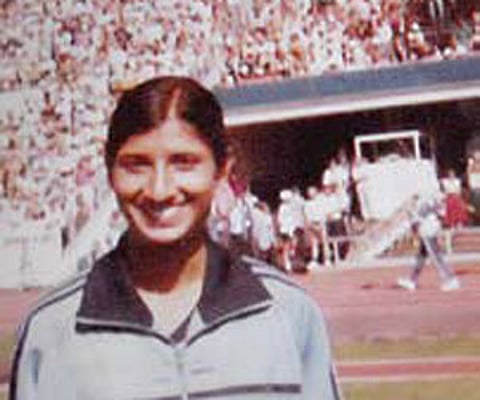

KOCHI: “By the time I reached Class 10 at the Thaliparamba Seethi Sahib school at Kannur, I had come first in the 100 m, 200 m, 400 m, 800 m and the long jump at the district level,” says Mercy Kuttan. Soon she was selected to represent Kerala at the national school championships.
At that time Mercy was staying 15 km from the school. “I had to walk 12 km and then take a bus. It was quite tiring.” To allow her to spend more time in training, an accommodative school management allowed Mercy to stay free at the boarding.
At the championship at Thiruvananthapuram in 1978, Mercy broke the long jump record. “It stayed in my name for 19 years.” This was the first time the school had a national record holder on its rolls. “I was given a grand welcome by the teachers and the students when I returned to school.
It was a turning point for me because I realised I could be a successful athlete.” Mercy joined the sports hostel at Palakkad and came under the tutelage of coach A K Kutty. “There were ten students, among whom was M D Valsamma (who later won a gold medal at the Asian Games). In 1980, Mercy was asked to participate in the selection camp for the Indian team for the Moscow Olympics. At the camp, she met Murali Kuttan, a 400 m runner.
Says Murali, “For me, it was love at first sight.” Murali expressed his feelings but Mercy rejected him outright! “At that time I was focused on my career and had no thoughts of romance,” she says. But Murali persisted and played a few mind games. He avoided taking meals in the canteen at the same time as Mercy. Murali’s fellow athletes, like Udaya Prabhu, told Mercy her suitor had stopped eating because he was depressed. Slowly, Mercy was won over and they became a couple.
T his angered J S Saini, the chief coach. “He said I should concentrate on my career instead of thinking of marriage,” she says. Mercy was 18 and Murali was 26 and his career was coming to an end. For not listening to her coach, Mercy paid a high price. She was not selected to represent India at the Olympics even though she was the best in long jump in India. To mollify her, Mercy was allowed to go to Moscow as a member of a governmentsponsored youth delegation. “I watched the events as a spectator. It was a painful experience.” But an undeterred Mercy began training hard again. “I got a bronze in the long jump in the Asian Track and Field championships at Tokyo. My confidence grew.” After the championships, Mercy and Murali tied the knot on August 17, 1981. The same year, she began training with Murali at the Tate Steel athletics facilities in Jamshedpur where they were employed. At the 1982 Asian Games in Delhi, Mercy aimed for the gold medal. She did a jump of 6.48 m.
The stadium broke into loud applause.
A track official held up the white flag, signifying a clean jump. However, a few moments later, Bhatt, the chief judge, raised the red flag.
“I don’t blame Bhatt,” says Mercy.
“He was doing his job. I did cross the line but it was difficult to see the mark with the naked eye.” Chinese girl Liao Wenfen won with a leap of 6.41 m while Mercy with 6.26 m took the silver.
In 1983, Mercy took part in the inaugural World Athletics championships at Helsinki but failed to make a mark. By 1984, Mercy realised the Olympic qualifying mark for the long jump was difficult to achieve. So she and Murali decided to start a family.
Two years after her delivery on April 4, 1985, the thought arose in Mercy that she should try to fulfil her dream of taking part in the Olympics. “When I expressed my desire to Murali, he was very supportive.” Both of them felt Mercy stood a better chance if she shifted to the 400 m athletic event.
“We would take the baby in a pram for the training sessions,” says Mercy. “It was a difficult adjustment to shift from one event to another so late in one’s career. I had to work very hard.” But in ten months, she won her first 400 m event at the Kanpur nationals when she defeated runners including Ashwini Nachappa, Shiny Wilson, Vandana Shanbhag and Vandana Rao.
She won 400 m competitions regularly and was able to fulfil her dream - she was selected for the Indian team for the 1988 Olympic Games at Seoul.
“It was at Seoul that I realised, with a sense of shock, the gulf in standards between us and world class athletes,” she says. Mercy reached the second round of the 400 m before she was eliminated. “But I am an Olympian,” says Mercy, who won the Arjuna Award in 1989. “Wherever I go, people refer to me as Olympian Mercy Kuttan.
Coming from a small village in Kannur, I consider this a huge achievement.”
shevlins@gmail.com
