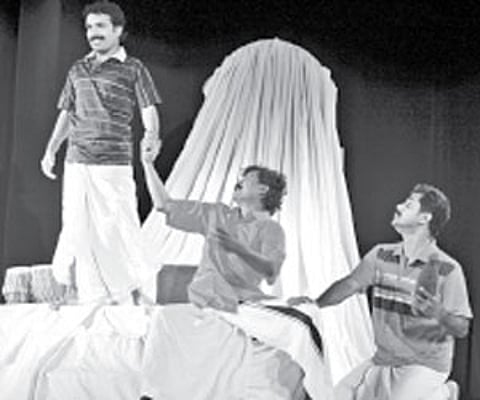

KOCHI: The 10-day long theatre festival at JT Pac began with the theatre version of K Damodaran’s ‘Pattabakki’ on Sunday. While Kavalam’s ‘Bhagavatha Jugam’ staged on Monday unveiled different aspects of theatre movements in the State, Navakerala Kala Samithy’s ‘Bashtukara’ staged on the third day pulled at the heart strings.
In his introductory speech, Chandradas, director ‘Pattabakki’, urged the viewers to get ready for a different theatre experience.
He said that in his play the viewers were also characters who communicated with those on stage. But neither the director nor the actors could effectively convey the message of the play that tried to expose a dark era in Kerala history. The director who claimed that the drama was not just an antique piece to portray the atrocities faced by tenants from landlords failed to live up to expectations. The properties displayed on the dais, a tea shop which was later converted into a provision store, a hut and the bungalow of the landlord which was meant to create a mood of the feudalistic age could not take the viewers to that era. Neither did the actors merge with the characters of the era which witnessed atrocities aplenty. Most of the characters presented the sharp and thought provoking dialogues penned the celebrity writer K Damodaran like amateur actors.
However the second day of theatre festival turned to be a feast for theatre buffs as Sopanam, the theatre group of veteran thespian Kavalam Narayana Panicker, easily and professionally convinced the viewers about the infinite possibilities of theatre through the ‘Bhagavatha Jugam’. Minimum use of stage properties and the natural flow of dialogues impressed all.
The satirical Malayalam version of the seventh century Sanskrit play ‘Bhagavatha Jugam’ of Bohayanan unveiled the pseudo spirituality of the society.
Powerpacked dialogues, convincing portrayal of characters like the drunken Vasantha Sena, the furious Guru and the confused disciple Shandilyan were well received. “The strength of the characters of Guru, Shandilyan and others were safe in the hands of the young artists,” said Ravi, a theatre buff who had seen the play three decades back with Nedumudi Venu as Guru and the late Bharath Gopi as Shandilyan.
Through the satirical conversations between Guru and Shandilyan, Kavalam captures the hollowness of pseudomorality. Sajikumar immortalised Shandilyan who symbolises the pitiable state of the layman who is trapped between morality and reality.
The scenes depicting the transformation of the Guru into the prostitute and Vasantha Sena going into the mannerisms of the saint symbolised the simulated faces of mankind. Gireesh as Guru and Saritha as Vasantha Sena presented stellar performances.
The costumes of the play designed by the late G Aravindan stood out for the mesmerising colour combinations. The reverberations of the traditional percussion instrument mizhavu contributed to many dramatic situations.
Navakerala Kala Samithy’s ‘Bashtukara’ staged on the third day of the theatre festival wet the eyes of many viewers. “The theme of the story haunted me for years. After a pilgrimage through the story I decided to give a theatrical version to it,” said Raju Naripatta, director of the play. “I was keen to uphold the immortal music of M S Baburaj. Though the writer presented him alive in the story by sketching the composer playing his harmonium in ‘Basthukara,’ I made a small change and incorporated the soulful music of Baburaj.” The narration of the story against a Muslim backdrop with dialogues presented in a Valluvanadan slang added to the beauty of the play. The mannerisms of the main character Aboobakkar were beautifully portrayed by Dinesh. Sugathan who played the role of Rasheed deserves special mention as he earned instant hatred for the character.
When the immortal songs of Babukka including ‘Pranasakhi njan verumoru’, ‘Iniyum puzhayozhukum’, ‘Kannerum swapnangalum’ and ‘Thedunnathaare shoonyathayil’ were merged with the story thread, the sequences got a soothing touch. Amidst the worries and anxieties over the frequent victory of dishonesty over honesty in musical and material life, the dramatist concludes the play with a ray of hope. The concluding scene had the little known composition of Baburaj, ‘Ithu mathram ithu mathram orma venam’ that hopes for a better future.
sivadasvarma@gmail.com
