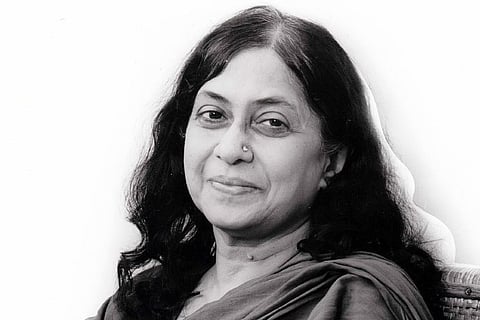

Was she man, woman or was she neither? Was she a flower, fruit or thorn? asks artist Anuradha Nalapat, recollecting precious moments with her aunt Kamala Suraiya.
One thing is certain. She is sure to live as an exclamation mark, teasing and prodding us, inspiring us to reinvent ourselves. We shall then wonder about this exclamation mark and its journey, she says .
Be a comma, an indomitable one; seems to be the message of the life she lived and devoured. Kamala Das was a movement, no doubt, but not an ‘ism’ that lends its shackles. She moved relentlessly through man, woman, through the lowly worm, the unmoving mountain and the blue sea and as she blew across she left behind its essence in the form of poetry.
“I give the woman-her voice;
I give the woman-her smell.”
Feminists claimed her because she lent her hand and raised them from their shackles but never put them on a platform. They forget that she never did offer a crutch, or a platform of convenience.
In ‘A Feminists Lament’ she observes,
‘Even Phoolan the dacoit queen
finally threw down her guns
to settle for weekly orgasms.’
The result of such bold poetry was that men and women abused her and flung at her half-baked judgments that only served to expose their own bonds, their own deficiencies in tight wraps.
But children adored her for her pranks, she was one amongst them, making sure the sweetest payasam was served to them along with the stories she told them.
She throws a question in
‘Twenty first century,
do you see me
Or do you avert your eyes
when I pass your way?
So what did she see and what did she want us to see? Did she want us to see that she was ahead of her times; that she was used to leaping and not walking? That the time for the ‘Feminists lament’ is over, or for that matter any other lament? The female of the species has already risen from her bondages and claimed her other half-her masculinity that was once taboo in society. But the very same thing she fought for, has that become the bondage now? Isn’t it yet time for the woman to let go of the ‘struggle’ she has undertaken for centuries?
A soul like Kamala Das rode both waves with extraordinary ease - feminity and masculinity. It is not her extraordinariness that we must aim for, but her ordinariness. She laughed, she cried, she cooked, she cleaned, she sewed, she did all that ordinary people did, but she transformed all that she did. Her mother Balamani Amma has written that Kamala is gifted with the ability to transform a moth into a butterfly and that’s exactly what she did with her life. She was extraordinary in even opening a packet of sugar. She didn’t snip the edges with a scissor. She just laid the packet flat in her hands and dug into its centre from the bottom with her fingers, tearing the plastic apart. I used to love seeing that; watching the sugar pour and fill the container. When she served us papaya, she would cut a whole papaya, say into two; at the most three boat shaped pieces. So we had this huge boat sitting in our plates waiting to be devoured. When she served rice payasam it would be one massive dish full. Always in plenty, never lacking. She constantly lived on the edge and only at the edge can one weave extraordinary cloaks like she did into ordinary life.
The movement called Kamala moved through fame and she describes thus the experience —
“Fame is merely the smoke
the kitchen-chimney emits
when you cook a meal.
Do not be awed by it
or give into pride.
Smoke is ordinary,
all it does is
cloud your vision.”
In ‘A kind of Fishing’ she says,
and shall fish out poetry
that is neither glad
nor sad
but can cut
precisely the gut
to wake you
out of dreams…
No wonder she called herself a river in spate, no one can contain.
After having flowed through the landscape of life she recognizes its essence.
As for love, that haunting piece of music singing in our blood, that from which she could not be separated like conjoined twins, she reminisces,
“My wayward search
for love
made me seem
ludicrous.
All searches are
ludicrous
there is grace
only in repose.
In another poem about love
I am left with
the hollowness of the word love
how shall I be rid of it
to become
totally free
to become wiser in the end?
And in the end she passed through the ancient blue god, her Krishna, a potent drug enriched over centuries and served right from childhood. He who paraded on her walls with cows and jingle bells and his gopis; he who lived through her and made her what she was; he who poured though her as Kamala, Madhavikutty, Suraiya……he took her along wherever he went, until she finally wrote,
‘Merry Christmas
happy new year
Here I go
leaving you
going is easy
as easy as arriving
when directions cease
to exist
pain and pleasure
taste the same
one becomes one’s own
collapsing axis.
The comma continues in ‘I shall live on…’’
After wearing centuries
when my name and form
cease to be
keep your ear
close to the ground
I shall be the thrumming
Of the impatient seed within
the plant pregnant with
next summer’s bloom.’
