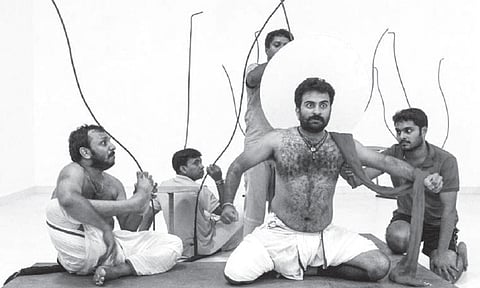

KOCHI: Hanuman is known as the hero who selflessly served his lord. That he never indulged in a private moment of joy is celebrated as a virtue. In fact, wrestlers consider his vow for lifelong celibacy to be the source of his superhuman strength. What then, if we were to learn, that Hanuman had a son? Playwright Prasanth Narayanan explores the premise in his latest production Makaradhwajan which premiered on Wednesday in Thiruvananthapuram.
Makaradhwajan, played with astonishing ease by Anoop S K M, is the son of Hanuman. Once in a while he would visit his mother, Makari, a beautiful mermaid who lives all to herself in the depths of the ocean. He cannot stay with his mother forever, as he is not a complete sea creature. Smiling like a baby imp, he plays hide-and-seek with her, forgetting that he has to return to the aching loneliness. It is interesting to find, in an ancient story, the modern paradox of suffering like lone islands even as we live amidst loved ones.
The playwright dug out the story idea from Kamba Ramayana. There it was only a germ of a story, maybe a passing reference of Hanuman’s potent sweat falling into the ocean, and causing Makari to conceive a son. There are a few versions of the Makaradhwajan story. In some, when Hanuman encounters Makaradhwajan, he has already grown into a fine young man serving the demon king. The playwright seems to have chosen Makaradhwajan to be a boy, as the chemistry between the son and his parents cannot be more endearing if he were any older. Moreover, it would not be as heartbreaking if Hanuman were to leave a well-rounded son to his plight in the end.
Adithya Singh Palawat, a National School of Drama alumnus, essays the role of Hanuman. In the beginning he is depicted as a god to be worshipped and feared. But when he transforms himself into a fly and tries to break into the palace Makaradhwajan is guarding, the son catches the fly. The ensuing torture of the insect is comical. Eventually Hanuman assumes his original form, and they have a face-off. Makaradhwajan matches up with the legendary hero, and rubbishes him off, to the great delight of an audience who perhaps expected a stiff commentary on loneliness as the director’s invitation note had suggested.
Parvathy Nambiar played Makari. The mother despite her loneliness, which she sings and sighs about, doesn’t ever stop her graceful smile. Even though the voice of the support singer suggested melancholy, the mother never breaks down.
A group of Ramaya singers becomes the connecting thread between the various scenes in the play. The play begins with a tableau of the Ramaya singers, who slowly come to life, and then start singing about their own origins. From here the play picks up pace. The set made of lightweight materials is smartly adjusted as one scene changes over for another.
The high point of the play is when Hanuman reveals his Viswaroopam. Accompanying the chenda, timila and mrudangam in the background, is a sudden burst of crackers. Seeing this Makaradhwajan faints down. And then Hanuman offers his precious final words to his son, “Maram chadi kaliykkeda makane!” There can’t be a funnier way to say “go and play”. The mocking tone and rustic humour of the narrative, in contrast to the thought-provoking message of the story, is welcome.