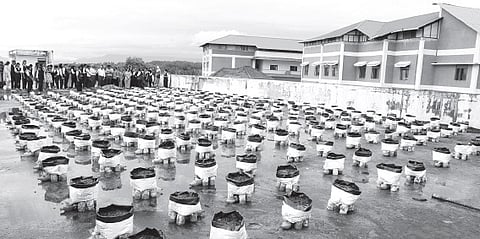

The students of KMCT College of Engineering for Women at Kalanthode, Kozhikode, have taken the first steps of organic farming. The rooftop organic garden at the college which utilises the ‘wick irrigation’ method was launched the other day by Kamalam Joseph, scientist at Centre for Water Resources Development and Management (CWRDM). The project envisaged by the NSS unit of the college is being supported financially and technically by CWRDM.

Elizabeth C Kuruvilla, principal, KMCT College of Engineering for Women, said that the project makes use of the wick technology developed by CWRDM which depends on inexpensive waste materials for irrigation. “The sole idea of the project is to make use of waste materials that help micro irrigation in organic farming. As part of the programme, awareness-creation and demonstration on wick irrigation technique for the neighbouring Kudumbhashree will also be carried out,” she added.
CWRDM officials said that wick irrigation, which is the latest micro irrigation method, was the most suited technique for indoor as well as outdoor gardening with the advantages of saving water, time and nutrients. “Plants need water regularly. Sometimes, people may have to be away from home or they forget to water the plants. In these circumstances, wick irrigation method can play a major role in making adequate amount of water available for plants and keeping them healthy,” says T Valsan, senior technical officer, CWRDM. The advantages of wick irrigation are many, he adds. “Water consumption is reduced since evaporation is almost eliminated, and less time is needed for refilling containers. Another advantage is that all the losses associated with conventional irrigation are eliminated in wick irrigation,” he says.
The theory behind wick watering is simple. A wick is run from the grow bag down through a drainage hole and into a reservoir holding water.
As soil in the bag dries out, capillary action from the soil draws water through the wick from the reservoir and re-hydrates the plants. When the soil reaches its moisture-bearing capacity, the wick stops drawing water. CWRDM has successfully developed two types of systems. The first consists of grow bag, a water bottle, wick made of glass wool and two bricks. The second system uses PVC pipe instead of water bottle.