
Classical writers like Pliny, Ptolemy, and the Periplus of the Erythraean Sea had recorded what they had learnt about the Roman trade contact with the west Coast of the Indian peninsula. Greek and Roman writers mention the harbour town of Muziris which was the main centre of this international trade. According to them, Muziris was the first emporium of India, controlled by the Cera chief who had his capital in the interior, in a place called Karoura. This is identified by the archaeologists as Karoura near Trichinopoly in Tamil Nadu. The Ceras from Karur must have used the Palghat gap and followed the river Periyar to its mouth in Kodungallur where Muziris was located.
The flourishing sea trade of Muziris in the first five centuries of the Christian era is attested to by the presence of Roman gold and silver coins in large numbers discovered in several places like Eyyaal, Kottayam, Valluvalli and Paravur. Ancient writers also mention sandal wood, teak, ivory and other hill produce besides pepper which they called black gold on account of its great commercial value.
The ancient Tamil poems of the Sangam age have mentioned the harbour of Muciri to which the Yavanas (Romans) brought their ships and exchanged gold for pepper. This place is identified as Cranganore(Kodungallur) since it is referred to as lying at the mouth of river Periyar. In 1341 AD a great flood seems to have changed the configuration of the river mouth and sent many parts of the Muziris harbour to the bottom of the sea.
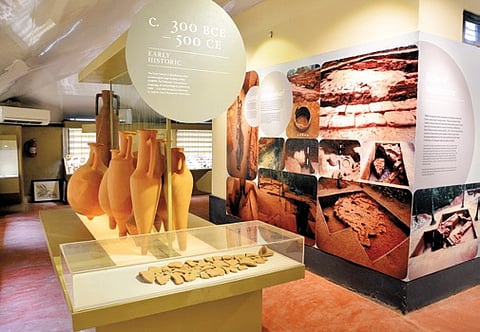
Recently when an archaeological site called Pattanam was excavated near Paravur, some scholars had speculated that this was the site of the ancient Muziris. Archaeological excavations have been undertaken at the site for several years, and much interesting pottery and semi-precious beads have been collected from there. The diggers claimed to have found a brick platform and parts of a small boat, but no serious archaeologist would suggest that this is proof of the Muziris harbour on that site. Moreover these relics have been destroyed by the excavators themselves!
However, much propaganda is made to the effect that the Kerala Council discovered Muziris at Pattanam. The Archaeological Survey of India has refused to accept the claim as genuine. Many tourist facilities, including roads and museums, have been named as part of Muziris project, but there is no scientific basis for calling Pattanam as Muziris. This is an international hoax in the field of archaeology sponsored by some political groups and tourist firms of Kerala. Excavations in Pattanam will suggest that it was a bead-manufacturing centre and market place. It has proved nothing else except the fact that some Keralites are out to cheat the world and others are willing to be cheated.
It is unfortunate that the President of India is dragged into this game by including his visit to Pattanam as part of the so-called Muziris project, indirectly conferring legitimacy on the false claim about Pattanam as the site of old Muziris (Muciri), the major harbour of ancient Kerala. In fact, the Jewish copper plate of Bhaskara Ravi, the Ceraman Perumal (999-1000AD) has stated that it was issued at his capital called Muyirikode, which is none other than Muciri of early times. From this it is clear that Muciri was located in Kodungallur, the capital of the Perumals of Kerala and a flourishing harbour until the 14th century of the Christian era.
