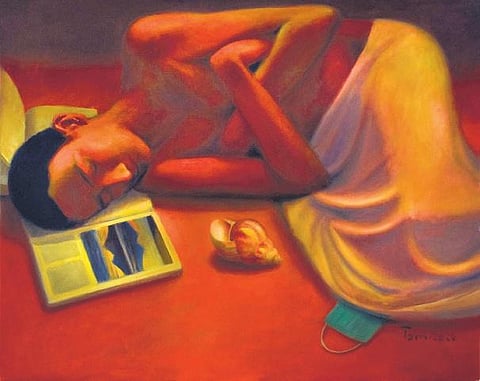

KOCHI: Artist Tom Vattakuzhy believes that art is an emotional response to the world around us. This painter and illustrator has experienced visual art all his life, and he dwells deep into its ends. “The idea is for us to be sensitive. Art travels with time, and things that touch our minds manifest as a feeling which later transcends into art,” he says. Tom equates it to a stone moving towards a pool of water. The ripples it creates, according to him, is the art. His new painting, named ‘Slumber’, is an ode to the world being haunted by laziness and boredom.
Winner of many national and state-level awards like the All India Fine Arts and Crafts Society Award, Kerala Lalithakala Akademi Award, and Haren Das Award, this 53-year-old artist is noted for the way he brings about light effects in his paintings. In ‘Slumber’ and especially ‘The Mystic’, there is an unseen mystery to the way he plays around with emotions as if being reflected by light on his canvas. But he likes to see it as a part of the content that stimulates the narrative.
“Our horizons of freedom are turning murkier. The political situation has become questionable -- a sort of post-liberal political scenario, paired with uncertainty regarding where we are headed, as a race and individually. This is making all of us apprehensive. Art nowadays has darkness and murkiness to it; a certain sense of melancholy it creates in artists who can touch the nerve of society,” he says.
In the early 90s, Tom had his share of art and soul searching. An alumnus of Santiniketan Visva-Bharati University and Maharaja Sayajirao University of Baroda of Baroda, he studied under artists like M V Devan and Prof M V Krisnan. “When I was studying, we were at the threshold of a paradigm shift in art- from modernism to postmodernism. For an artist, thisdecides where he stands, where his foothold is in the field,” he says. The need to step away from the trend and look within is what drove him towards the language of art he uses now. But that undercurrent of change, may have gone too far, he believes.
The conversation reminded yours truly of an installation by Young-hae Chang Heavy Industries (YHCHI) at the Kochi Muziris Biennale 2018, about how there is no good or bad art. According to Tom, this may be true. We may be at a point of lack of objectivity where anything can be art. “Whatever used to be considered as value or virtue in art has been setaside. Look at the colour, or depth, all those elements are now optional. It has come to a point where the very character of cutting edge art is negation,” he believes.
Tom also adds that this may be a result of art growing more and more self-conscious - something literature, or a more recent form like cinema doesn’t experience. “Art is observing and questioning itself. Almost like peeling an onion. But sometimes I think those who peel more than they should, might find it empty in the end,” he adds.