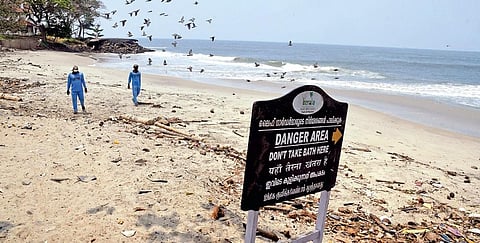

KOCHI: Since the pandemic outbreak restricted our travelling options, local beaches have become the go-to spots for domestic tourists. But how safe are our beaches? Fort Kochi and Valappu, two of the most sought- after locations, have become death traps. Though the authorities have deployed life guards, visitors rarely pay attention to their warnings. A recent incident where a 12-year-old boy drowned at Fort Kochi beach throws light on the need for proper monitoring
Aresident of Fort Kochi, 37-year-old Thomas Ranjith Louis, has a long-term acquaintance with its beaches. But on Sunday, as he was enjoying a morning stroll around 6.30am, he saw two children caught in a big tide — about 50 metres high — away from the shore. They were waving their hands, desperately looking for help. Without any hesitation, Louis jumped in and pulled the children to the shore.
As he stood there grasping for breath, Louis saw another boy struggling to stay afloat. “As I swam towards him, I noticed that the boy was trying hard to stay afloat, swimming against a strong top current. Luckily, he was a good swimmer and he managed to keep his balance till I got to him. He was panicking. But when I returned to shore with the third boy, the others told me that there was a fourth member in the group who is still missing. Though we searched the waters hard, we could not locate him,” Louis said.On Monday, the body of the missing 12-year-old boy, identified as Al-Amaan, son of Riyaz, Seelattu Parambil, Fort Kochi, was recovered.
“I believe Amaan was caught in the strong undercurrent which pulled him deep into the sea. Had we spotted him, we could have saved him,” Louissaid. Ranjith adds that almost all children who visit the Fort Kochi beach like to bathe in the sea. “A majority of them know swimming. But that’s not enough because the current and top current in the sea are powerful. It’s not that easy to stay afloat in the sea when waves become very strong,” Ranjith added.
No time restrictions, no strict rules
For the last 14 years, Varghese K J, 40, Raju T A, 48, and Premjith C P, 39, have been working as lifeguards at different beaches in the district. Since March 2020, they have been posted at Fort Kochi beach. They spend their duty time between 7am and 7pm warning visitors to stay away from deep waters if the sea becomes rough. “Visitors from outside heed to our advice and warnings. But it’s the locals who just don’t obey us. They venture into the sea claiming they are good and regular swimmers,” said Premjith. He adds that many visit beaches early in the morning and in the night, when the lifeguards are off duty. “If we are on duty, we keep a close watch. We have saved a lot of people who were caught in the high waves,” Varghese said, adding that though they were appointed on contract basis by the district tourism department, they don’t have life insurance.
Dept takes little care of lifeguards
Though the tourism department has provided the life guards a room at the beach, it lacks a bathroom and water supply. “We have to walk a kilometre to reach the bathroom. Once we undertake a rescue mission in the sea, we have to stay drenched in salt water for hours,” said Premjith.
HOW SAFE ARE OUR SPOTS?
Fort Kochi Beach
Kuzhuppilly Beach
Munambam Beach
Puthuvype Beach
