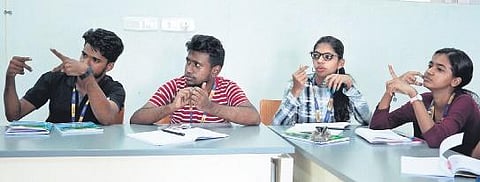

KOCHI: Back in the 90s, the good-old Doordarshan introduced weekly news bulletins in sign language for people with hearing and speech disabilities. It was quite an ‘inclusive’ leap. After the initial sense of amusement, the general audience welcomed it. The bulletins became a regular fixture, and some people attempted to learn sign language by watching the telecast.
Decades later, in 2018, the Union government urged the regional news channels to bring sign language interpretation in at least one news bulletin. Asianet News led the way in Kerala. It added a SLI bulletin on September 23, 2018, the International Day of Sign Languages. Asianet executive editor S Biju says the initiative was a challenging one — production nuances, readjusting graphics, and the aesthetics.

“The bulletins are live and the SLI has to match with the anchor’s speed,” he adds. “Next, we should tap artificial intelligence to show programmes in the embedded language. Organisations like the National Institute of Speech & Hearing (NISH), Thiruvananthapuram, have started work on news automation.”
Currently, most prominent Malayalam news channels have bulletins with sign language interpreters (SLIs) sharing screen space with anchors. Notably, a majority of SLIs have been trained by NISH, which is marking its 25th year of service.
One star NISH alumnus is B S Vinayachandran, who works with Asianet, Mathrubhumi and Manorama news channels. The ace SLI says he has been deeply influenced by Dawn Jani Birley, a popular Canadian hearing-impaired theatre actor, educator, television anchor and motivational speaker.
Vinayachandran, who hails from Thonnakkal in Thiruvananthapuram, has postgraduate degrees in several subjects, including linguistics, sociology and library science. He says the “turning point” of his life was meeting a youth with hearing and speech disabilities at a book shop.
“The boy was doing manual labour,” Vinayachandran recalls. “I saw him carrying a huge load of books at the shop. The shop owner informed me that the boy was an engineering graduate.” Vinayachandran tried interacting with the youth. “It was a struggle,” he adds. “That encounter haunted me the whole day. At night, by coincidence, I saw a NISH ad calling for applications for a one-year diploma course.”
Vinayachandran enrolled and topped the course. He then headed to Odisha to enhance his skills under Sibaji Panda, who works to uplift the hearing impaired. Subsequently, Vinayachandran joined various associations and NGOs working for the benefit of people with hearing and speech disabilities.
The pandemic was yet another turning point. Vinayachandran did sign language interpretation of Chief Minister Pinarayi Vijayan’s daily press meets. They were widely appreciated. “I also did several social media videos for Prime Minister Narendra Modi’s Mann Ki Baat,” he says.
‘Kathakali, koprayam jibes’
While most people lauded his efforts, there were insensitive elements of society who ridiculed him.
“There have been instances where people jeered that what I do is Kathakali or koprayam (buffoonery) on TV,” he says. “However, I take such comments in my stride, see them as an acknowledgement.”
Vinayachandran, who is gearing up for his wedding next month, says there were many people who looked down upon him as he earned his livelihood from sign language.
Brushing aside disdain with a smile, Vinayachandran says SLIs have a complex task at hand. Facial expressions, too, are crucial, he says. Also, SLIs have to be abreast of current affairs and give background or recap of developing stories swiftly.
Double role
Chitra Prasad, a NISH lecturer who works as an SLI with several leading Malayalam news channels, says that initially there was resistance. “Some feedback the channels got was blunt,” she recalls.
“People questioned the need for SLIs; some even complained against the initiative! But I believe such mindsets have changed for good.”
U B Bhavana, too, is a NISH faculty member, who regularly appears on news channels. “I mastered sign language by interacting with my students, who have hearing and speech disabilities,” says Bhavana.
“Since I have learned Bharatanatyam, it is easy for me to understand sign language. And, I love interpreting sign language in news channels. I don’t care about mockery.”
‘Facial expression crucial’
The academic coordinator at NISH, Daisy Sebastian, says beyond technical practice, facial gestures are “the most crucial factor” when it comes to presenting news. “For example, when a news anchor presents a story on a protest or a disaster, the interpreter should convey the mood, the emotion through facial expressions,” she adds.
Daisy would understand the nuances well. She chose this career to promote the well-being of youngsters like her son Denny, 32, who was born with hearing and speech disabilities.
NISH AT A GLANCE
Hardcore fan
Trivandrum Association of the Deaf vice president B Reghukumaran Nair, 74, is a ‘fan’ of sign language news. The former Cochin Shipyard employee eagerly looks forward to watching news bulletins from 2:30 pm to 4:30pm that have sign language interpreters (SLIs) along with regular anchors. Reghukumaran lost his R Chandrika, who also had hearing and speech disabilities, died a decade ago. He was left heartbroken, says his younger daughter, R C Neenu, a mother of two. “It took him years to reconcile. She was his soul mate, and the two communicated in sign language,” she adds. “After Amma’s demise, Achan went into a shell. My children interacted with him in their own sign language. That helped him bounce back to normal life. Then, the entry of sign language news bulletins had him hooked.” Reghukumaran wants more sign language options. He feels disappointed that he is unable to laugh with his grandchildren while watching comedy skits on the television.