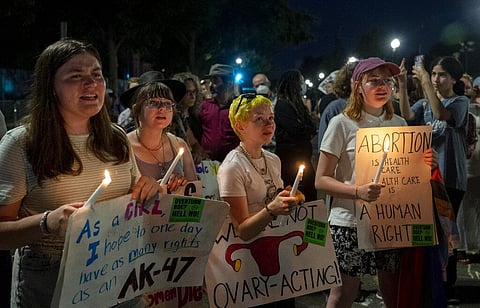

KOCHI: The recent US supreme court ruling that ended constitutional protection for abortions has stirred a global debate, with a majority terming the verdict regressive. TNIE takes a look at the scene in Kerala
In India, the Medical Termination of Pregnancy Act, passed in 1971, permitted licenced medical professionals to perform abortions based on certain conditions. Last year, an amendment to the Act expanded women’s access to safe abortions from 20 to 24 weeks of gestation. Though considered to be having progressive laws on abortions, women in India still struggle to exercise their rights, owing to adverse social settings and lack of awareness.

Take the case of Smitha (name changed), who had to go through an ordeal to undergo an abortion, as she and her husband decided to terminate an unwanted pregnancy.“I have a 2.5-year-old child,” says Smitha, 32.
“When I became pregnant, despite adopting contraceptive measures, we decided to get an abortion done. We were totally unprepared, and decided to terminate it. We approached two major private hospitals in Alappuzha, but they refused to do it even though the pregnancy had not progressed even for a few weeks. One of the hospitals told me they would provide medical care only for miscarriages, and that many people get admitted their after taking abortion pills.
”Kochi-based Soumiya (name changed), a single woman in her mid-20s, says she is yet to recover from a distressing abortion experience.
“As I was petrified, I took my friend along to consult a renowned gynecologist in the city,” she recalls. “The doctor was judgemental and rude. As my friend spoke on my behalf, since I was in a weak mental state, the doctor snapped at her, asking, ‘Are you responsible for her pregnancy?’”
Soumiya says the doctor blamed her as if she had committed a crime. “She asked me: ‘You never thought of your parents?’ She kept asking for my parents’ contact to seek their opinion. I felt as if I had no right over my body. And those stares from the nursing staff make you feel like hell.
After that incident, I decided not to seek any help from the doctors in Kerala. Later I got the abortion done in Hyderabad, where doctors were nonjudgmental, and the procedure was smooth. ”Women’s health experts note the negative mindset and lack of clarity on laws push women to go for unsafe abortions. According to a United Nations Population Fund study, 67 per cent abortions in India are unsafe and cause nearly eight deaths every day.
It is high time the Centre or the Kerala government brought in more clarity and proper guidelines so that hospitals adhere to the laws, say women’s rights activists. “Even the Government Medical College Hospital does not offer abortion. When a woman approaches a hosptial for an abortion, she is often asked to produce the consent of the husband or male partner. This is against the MPT Act, which leaves the decision to women,” points out activist-lawyer J Sandhya.
“I once had a client who had to take the matter to the court and the Women’s Commission. When contacted, the hospital said they were insisting on the consent of the husband to avoid legal tussles. Despite laws, in reality, it’s much more for women than what it appears to be. I recently submitted a memorandum to the state government to issue a circular on guidelines to be followed at the hospitals, but there has been no response yet.”
WHAT THE LAW SAYS?
The Medical Termination of Pregnancy Act, passed in 1971, allowed registered medical practitioners to carry out abortion up to 20 weeks of gestation. In 2021, an amendment extended the ceiling to 24 weeks, and allowed abortions even after that period if substantial foetal abnormalities are diagnosed. A second doctor’s opinion is mandatory to terminate pregnancies between 20 and 24 weeks. “As per the rule, abortion can be carried out if: the pregnancy poses a risk to the life of the woman or affects her mentally; If the child would suffer from any physical or mental abnormalities; if the pregnancy is caused by failure of birth control methods; the pregnancy is caused by rape,” explains gynaecologist and writer Dr Khadija Mumtaz. Following the 2021 amendment, these rights were extended to unmarried women, too. “Women aged 18 or above can approach a gynaecologist for abortion. In cases of married women, spousal consent is not necessary. Similarly, if you are unmarried, parental consent is not required. Many doctors ask for consent due to their lack of awareness of the law, or when they keep their personal beliefs over norms. Consent is required only in cases where the patient is a minor or mentally challenged.”