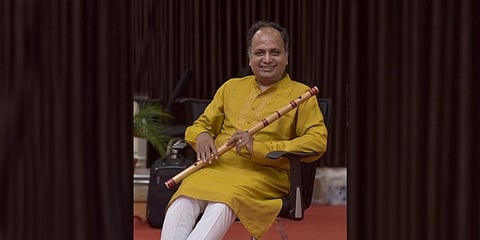

KOCHI: The sweet notes that flowed from a window of a music classroom in Odisha changed a youngster’s life. The melodious sound and the instrument fascinated the youth so much that he picked it up and never put it down. That was the start of the musical journey of Himanshu Nanda, today a well-known flautist in India and abroad. He is the senior disciple of Hindustani Classical flautist Pandit Hariprasad Chaurasia.
Another interesting fact about Himanshu is his close relationship with Kerala, which started 10 years ago and continues. Himanshu has a very close connection with Kerala. “I have been touring Kerala for the past six years and have a very good student base. The first Bansuri School was opened at Panayam near Kollam on February 12, 2018. The panchayat was the first to take the initiative to spread Hindustani Bansuri in Kerala,” he says.
At CUSAT, where he performed recently, he sat down for a chat and walked down memory lane. “I come from a family with no musical traditions. However, my grandfather used to sing bhajans, and I too used to sing in school choirs,” he starts.
“Though I wanted to learn music, I didn’t get a chance since there were no music schools in my home town at that time. So, I completed my schooling and then went on to college. And at that time, a music school opened in my hometown Bhawanipatna,” adds the maestro. Himanshu decided to go check it out. “When I went there, a flute class was going on. The melodious music attracted me and I decided to join the school,” he says.
However, the young Himanshu wanted to learn everything about music. “The teacher asked me to choose any instrument. I told him that I wanted to learn everything. However, he asked me to choose one and focus on one,” the maestro says. “That’s how I chose the flute, the sweet notes that drew me to the school. Since then, I have been single-mindedly focused on it,” adds Himanshu.
It was destiny that made him a flautist, he believes. “You don’t choose the instrument. It is the other way. And I am happy that the flute chose me. I am content in this life journey.” It was the start, he says. “I began participating in competitions that I topped every time and maybe these competitions solidified my desire to become a flautist.”
Himanshu says meeting his guru Pandit Hariprasad Chaurasia was the focal point in his journey as a musician. “It happened quite coincidentally. I was in Delhi for my father’s bypass surgery. It was then that I came across a newspaper ad of a concert. I wanted to attend it and somehow managed to get a ticket.”
That was the first time he was seeing his future guru. “I used to listen to his recitals on TV. But that was the first time I got to see him live.” It was a turning point, and Himanshu terms it an “inner calling”.
After the concert, Himanshu expressed his desire to become a disciple of Chaurasiya. “To that, he said, ‘Come over to Bombay’ and I went,” says the flautist.
“However, even after becoming his student, I felt like something was missing. I was not feeling content. So, when I told my guruji about it, he asked me to come and stay at his Gurukul. But with one condition: I had to leave everything behind. I did that. Even left my phone behind... My five years at the gurukul transformed me and my relationship with music.”
Now, Himanshu, who started The Mystic Bamboo school at Pimpri-Chinchwad in Maharashtra, has hundreds of disciples across the country. “Guru-shishya parampara is not just about learning music, but also seeing your guru and living with him, learning about his approach towards life and music and how both are connected. I got to learn all these during my days with the guru,” he says.
Himanshu had a close relationship with Chaurasiya. “But he is a person of very few words,” he adds.
As for a unique style of playing music, he says, “I don’t think I own a style of my own. It is a revelation that comes from the inside and that happens when touched by the guru. So, whatever I have it is due to him,” says Himanshu.
Today he is taking classes both online and offline. He has also launched many initiatives. He started Mystic Bamboo, began ‘Bansuri Intensives’, workshops titled MQ 2 HQ, bansuri meditation and a project titled Music and Autism.
Himanshu is an advocate of music therapy and believes that Indian classical music has an important role to play in our mental health and general well-being. “Its healing power offers great scope in the treatment of children with autism, and their social integration” he says. “A prime example of the effectiveness of music therapy for autism is Pratibha Kamath, daughter of Dr Rajeev Kamath. She can perform hour-long sitar recitals.”
As we wind up the interaction, Himanshu says he has much to learn. “I am still searching. The essence of music, as I interpret it, is silence. The outcome of music, according to me, is silence. I am trying to attain that quietness.”