
KOCHI: It’s a bright morning in Fort Kochi. Kochi Biennale Foundation president Bose Krishnamachari’s phone keeps buzzing, and he struggles to polish off a classic English breakfast. Most of the calls are from different venues gearing up for Asia’s largest contemporary art festival, set for launch on December 12.
The fifth Kochi-Muziris Biennale was slated for December 2020. And that’s when Covid struck. So, in a way, the 2022 edition is not just a celebration of art; it would symbolise a fantastic comeback of the creative world.
“The energy during the biennale will be infectious,” says Bose. The ‘infection’ here is not limited to the creme and the connoisseurs. There is a sense of collective ownership among Keralites, Bose notes.
“Usually art lovers and collectors occupy a biennale,” he says. “However, our visitors are consistently mixed — who’s who from around the world, and the people on the ground. Now everyone in Kerala knows what biennale is. Elitism gets erased here. That’s why Kochi Biennale is different.”

Economic boost
Bose recalls the art scene exploding in India. “In 1989, when M F Hussain sold one of his paintings, it grabbed national attention,” says Bose. “There was a lot of talking and writing, and the economics came into the picture.” Economics comes into play in the Kochi Biennale, too. It is expected to give the tourism and service sectors of the state a much-needed boost.
However, Bose highlights that organising the biennale is a costly affair. The estimated expenditure could go over Rs 20 crore. “The state government has promised Rs 7 crore,” he says. “The rest has to come from CSR funds, donations, art patrons, friends, etc. Raising funds is a major challenge.”
Bose terms biennale a “soft power”, and adds there won’t be advertisements or announcements of sponsors. “It is difficult to get funds from the state, too,” he says. “Also, there are various audits carried out by CSR teams and the CAG.”
Besides monetary challenges, there are logistical, ground-level nitty-gritty to be handled with care.
“People don’t know the work that goes behind the scenes,” says Bose. “It is not like organising other festivals. For instance, our artworks are installed by local people. We educate them — including headload workers — on how to handle art. Well, it is not easy, tussles will happen. However, the show must go on; it will.”
Ground Zero
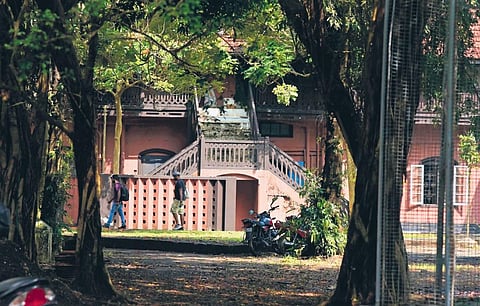
After breakfast and rounds of green tea and coffee, we head to Fort Kochi’s Aspinwall House, one of the flagship venues of the biennale. Local residents on the street cheerfully greet Bose as he rides pillion on a scooter. Express lensman A Sanesh and I follow him on another scooter. At Aspinwall, a portion of the tiled roof is dilapidated. The complex is in a shambles.
Inside, electricians and carpenters are busy with their artworks of a different kind. Welders, meanwhile, add intermittent sparkles to the interiors. The cacophony in the air hints at the dramatic transformation the colonial-era structure would undergo over the coming days.
It’s what they call good chaos. One of the biennale coordinators walks up to us and informs Bose that a viper was found inside the hall. “Now, it is safe to check out,” he assures. A film shooting was on here till recently, says Bose. “You can see the props left behind. There were weeds everywhere; we just finished the first round of cleaning,” he adds.
Soon, artists would visit the site to visualise their installations. “They need time to set up their work... some installations require sound and visual effects,” says Bose. The coordinator is confident: “We will finish the work in 20 days.”
‘Umpteen things to do’
Otherwise calm and chilled-out, Bose seems to have ants in his pants as we visit the sites. “From zeroing down on the artists, and the kind of works painting, sculptures, installations, augmented reality, collectives to the size of the works, the materials, insurance, customs bonds... there are so many aspects to it,” he explains.
“Then, of course, art handling and transportation, which are new to Kochi. There are umpteen things to keep in mind.” When it comes to setting up a venue, Bose shares, the detailing is important. “There was a time when Kerala had art exhibitions hanging works by a thread. Today, we should look at how to light up the work, the space around it, the surroundings... there are many minute details to look into,” he says.
At our next destination, Pepper House, basic renovation is in the final stage. Downstairs, temporary walls have been set up. “Upstairs, the ceilings need huge work,” says a coordinator. “We are waiting for a load of plywood. Then, painting has to be done.”
Bose says one installation will be made of bamboo, as he informs the young team members about materials to be procured. At the Anand warehouse, too, renovation is gaining pace. Bose says there will be sound-related works here.
Bose has a talk scheduled for later in the day. Before leaving, he shares what fuels him. “People say this is the biggest art event India has seen. That gives us confidence,” he says.
The local pulse
Next, I approach the local community to gauge the public mood in the Fort Kochi-Mattancherry area. Autorickshaw drivers and vendors seem excited. “Once the biennale begins, visitors will throng the city,” says Arif, an autorickshaw driver. “That’s good for us.”
His friend Ijaz sees beyond the financial benefit. “We don’t know much about art,” he says. “But, it is important to explore such exhibitions. Before the Biennale, we had never seen such artworks in our whole lives.”
Shijaz Ashraf, a roadside vendor in Mattancherry, expects a tourism wave. “Business is fine now. Currently, most visitors are domestic tourists. We expect more foreigners during the biennale, which coincides with the Christmas season.”
Vendor Muhammed, 70, echoes similar excitement. “Passenger ships will start coming soon,” he says. “We are betting big on the biennale.”
Meet the curator
Shubigi Rao is an Indian artist, writer, and thinker based in Singapore. Currently displaying her series ‘Pulp’ at the Venice Biennale, the curator has titled the 2022 Biennale ‘In Our Veins Flow Ink and Fire’.