
KOCHI: Is it necessary to hurt animals for our survival?,” asks Christina Ajith. The 23-year-old and her mother switched to veganism after a life-altering incident. “It forced us to reshape our outlook,” says the duo, who runs the sprawling vegan stay, ‘Lilac Farm’.
Tucked away from the city of Bengaluru, Lilac Farm encourages people to be more in tune with nature, feel the wind and unwind from the mundane life among the high-rise buildings. The organic farm stay, on 13 acres of land, offers a scrumptious feast with home-grown ingredients. They have over 80 varieties of fruits and vegetables on the farm.
The initiative aims to promote veganism. “Though we expect people to choose a vegan lifestyle, it’s a switch that can’t be made overnight. We don’t need 100 perfect vegans, some imperfect vegans would do. Because every choice, every meal, impacts a life,” says Anitha.

Moving away from meat
The duo, who hails from Kollam, says their love for meat was constant. “In fact, I’d eat chicken four times a day, munch on fish finger chips daily... Meat-filled diet was my comfort food,” says Christina.
However, in 2019, she was diagnosed with lupus, an auto-immune disease. Switching to a plant-based diet became the only option for her.
“The realisation that my child would have to rely on medicines and continue with a plant-based diet for the rest of her life, made our family collectively switch to a plant-based life,” says Anitha. However, Christina’s passion for cooking led to many hours of experimentation in the kitchen. “It was difficult to accept the change. Initially, my mother made me a salad with a lot of leafy vegetables. At one point, I used to cry while having them. Being a foodie, I didn’t want to restrict myself to limited options. And I refused to compromise on taste,” says Christina.
Veganism is still an overwhelming concept in India, she adds. “It is not just about Western food, or anything fancy. It is quite simple, any daily diet can be changed to vegan if certain ingredients — say butter and ghee — are eliminated. For example, plain dosa, puttu and kadala can all be vegan,” Christina explains.
No more dairy farming
The most interesting thing is, the Lilac Farm was made after converting their six-year-old dairy farm near Somashettyhalli in Bengaluru. Though they chose a plant-based lifestyle due to health issues, soon it came down to ethical reasons.
“Animal farming is an industry now. As a result, there is less emotional connection to living beings. We call ourselves animal lovers, however, at the end of the day, we are just pet lovers. We think of certain animals as food and that only some deserve love,” Christina says.
“So the question is, is animal cruelty essential for our survival when we can get an adequate amount of nutrition from plants?” When they started asking these questions, the answer became clear. The family came together and converted the dairy farm into a vegan farm-to-table retreat. They sold all the livestock and poultry. “We retained only a few sick cows and bulls to prevent them from getting slaughtered,” the duo says. Combining Christina’s passion for cooking and Anitha’s love for farming, the farm stay started to grow.
The verdant heaven
The retreat is a green haven filled with millet farm, papayas, lemon, gooseberry, cabbage, sweet potato, banana, pandan, tapioca, and much more vegetation, located just an hour away from the city. The space also has around 50 plus rescued animals — from ponies, guinea pigs, goats, and chicks, to sheep.
For the people who come by, the farm has a mud pool, rain dance, natural water body, stargazing deck, and trekking lanes to nearby places. “To understand the food on one’s plate, a connection with nature is essential. Unfortunately, those who live in the city have forgotten their roots. Children, on the other hand, consider ‘supermarket’ to be the origin of their food,” says Anitha.
Cow sheds to guest rooms
The name ‘Lilac’ refers to the purple colour flowers, but for the duo, the colour is synonymous with lupus awareness. “When Covid hit, we shifted to the farm as Christina was more prone to infection. The days spent at the farm and the food choices had visible changes in her health. That’s when we decided to open the space to the public so city dwellers would also get to experience the goodness of nature,” says Anitha.
Slowly the cow sheds were converted to guest rooms. Everything discarded and used found a place in the minimally styled farm stay. The duo also makes hibiscus concentrate, floral cocktail mixers, jams, pickles, and more at the farm.
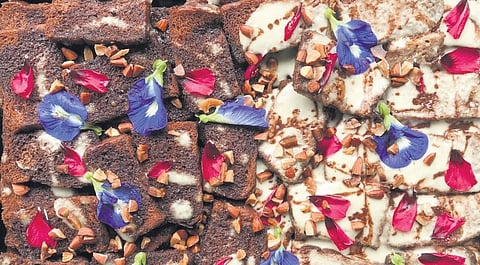
These choices are especially visible on the menu of the Lilac Farm. Wood-fired pizza, fresh fruit juices, beetroot puri, plant-based buttermilk, and tikkis are some mouthwatering delicacies. “We are making it clear that veganism is not bland but it’s tasty, healthy, and colourful. Who doesn’t like a plate full of rainbows,” says Christina.
Visit: www.thelilacfarm.in