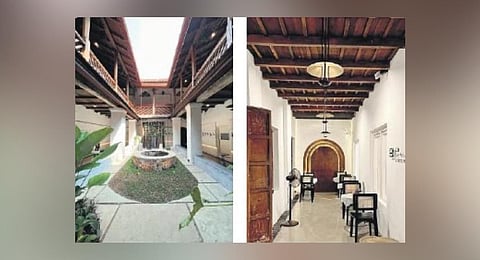

KOCHI: Proxim De PO, one of the houses built by the Dutch East India Company, is more than four centuries old. A stone’s throw away from the historic Parade Ground in Fort Kochi, the building has undergone many transformations. Among some recorded ones, it is said that a bank once functioned in the building. At another time, it was a school, its halls filled with the laughter of small children, and much later, a residence.
Architects Cyriac Panamkuzha and Thomas K Mathew played a pivotal role in transforming the house into an art cafe.
“The building with historical significance had become run down, and much of its furnishing and interiors had become dilapidated. But now, after much restoration, it proudly hosts a cafe and an art gallery, exhibiting the work of local artists,” Cyriac says.
“There are many such buildings in Fort Kochi, which is a cauldron that saw the amalgamation of various cultures. Besides the Portuguese, who ruled Fort Kochi for 160 years, it was colonised by the Dutch for 112 years, and later, by the British,” Cyriac adds.
During restoration works, the architects were very careful about not altering any elements of the building so as not to lose its old-world charm.
“We have restored nearly all the old furniture kept in the store rooms. As for the walls and other structures, we used lime and other materials that were used originally,” Cyriac says.
Particular about not disturbing the ambience of the building, the architects roped in artisans who were experts in the technique known as Pavaratti marble finish. “The 120-year-old stucco finish was developed in Kerala by the locals of Pavaratti with the help of Jesuit priests. Our research went into documenting the process thoroughly and applying it on different scales,” Cyriac says.
“The Pavaratti finish is a technique that mimics marble. In the past, getting marble was very difficult. The Pavaratti marble finish uses white cement, lime plaster, and oxide pigments to mimic the look. We got people from the area who knew about this particular finish. Working with them, we developed different marble textures.”
Taken on lease by four women entrepreneurs — Jenny, Princy, Julie and Praveen — the property is now gaining popularity as the Lila Art Cafe. The architect duo’s studio, Parinamah, hopes to popularise this forgotten technique through installations and collectables for everyday use.