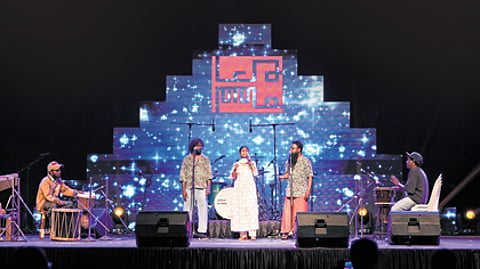

KOCHI: What is the source of music? Rather, how did language originate? Many a curious mind has for long lingered over these questions. They have searched vast and deep. Some of those searches were in the deep corners of nature where people still retain their links with Earth and the forests. The culture of sound that they follow lead the way of tribe people in various aspects of life, from sustenance to rituals to communication.
Modern languages have their source there in the woods, and if you have the mind to listen and tune in, the sounds of the forests may tell us stories of the source of language and its melodious twin, music.
Chetham, a band formed by a group of tribespeople from Wayanad, a region known for its culture linked to the forests, wants to do exactly that.
They listen to the language of the people of the forests, get deeper into the songs sung by them, and led by Mini Kanavu, who also acted in the film Manhole directed by Vidhu Vincent that earned the State Award for Best Film in 2017, Chetham finds ways to take it beyond the region to a wider audience.
“From my childhood, I have always loved singing. And I grew up surrounded by tribal songs. Tribal languages are not written down, as they do not have a script. But so many beautiful songs, each with layers of meaning, have been passed down through generations purely by word of mouth,” Mini says.

She wanted to bridge all these experiences, connect with the elders, study their songs, and understand how they came to be.
“There are many folk song bands in Kerala, yet the beauty of tribal songs is an unexplored area. Learning about the songs, I kept asking myself ‘Why shouldn’t these songs be shared with the world?’ That realisation sparked the idea behind Chetham.”
Mini’s journey is linked deeply to her tribal roots. She found inspiration at Kanavu, an alternative educational institute in Wayanad, and discovered a love for art and culture that shaped her path forward. Kanavu was the brainchild of filmmaker K J Baby and his wife Sherly Joseph who valued art as an integral part of education.
Students at Kanavu had the opportunity to explore various art forms, including the traditional martial arts, indigenous and folk arts, bharatanatyam, Hindustani music, and musical instruments.
Mini’s learning from the institution and dedication to providing educational opportunities for students from Sheduled Tribe and Sheduled Caste backgrounds led her to establish Gothrathalam.
“As part of Gothrathalam, we staged a play and composed songs to accompany it. That was just the beginning. We gathered a group of enthusiastic individuals and formed our band. What sets us apart is our dedication not only to the tribal songs of Kerala but also to those from across the country. Our work involves extensive travel, as we explore the cultures and music of different communities. It’s a challenging process; each tribe has its language, songs, and stories passed down through generations orally. We spent six months in Kolkata studying tribal songs. There is no shortcut other than becoming one of them. Because for us, more than just the music—it’s about understanding life. Travelling to rural areas where tribes reside allows us to absorb their songs and shape our band,” explains Sudhi Nammayan, co-founder of Chetham and partner of Mini.
Apart from the couple, there are four other members Suni Mari, Sarath, Abhijith, and Shajin.
The band travelled long from the northeast of the state to the capital city, to perform at the Kerala Arts and Craft Village as part of the week-long Women’s Day celebration.
The event marked their first performance outside their hometown since the band’s inception. The team enthralled the audience with offbeat rhythms and unique songs, quite different from the tunes of the mainstream. Composed of individuals from the Paniya and Vedan communities, the band holds a deeper purpose, says Sudhi.
“Our objective extends beyond music. We aim to unite artists from all communities, creating a culture that empowers them to use their skills to the best of their abilities.”
The composition of their band is so designed that it gives ample room for regional variations.
“In our region, instruments like the Thudi and Kuzhal are commonly used. Similarly, tribal songs from every state have their own set of instruments. Therefore, we try to incorporate authentic instruments from each state into our songs. Unlike others, we refuse to be confined to a particular genre or community. We also sing Tagore and Kabir. But our focus remains on showcasing the diversity of tribal songs from across the country.”
In a world where traditions and practices change by the minute, Chetham’s commitment is to conserve endangered songs from communities that remain hidden in the social fabric. The band’s work is also to build a bridge between the modern and the primal rhythms. Their music aims to transcend language and explore the connection music has with nature and life in a community.
“I’ve always wanted to stay rooted to the world of music. Our ultimate goal is to expand the band’s reach and use the songs to address social issues. We also want to learn new things from different parts of the country where stories wait to be told,” Mini adds.
Back to the roots
Chetham’s commitment is to conserve endangered songs from communities that remain hidden in the social fabric. The band’s work is also to build a bridge between the modern and the primal rhythms.