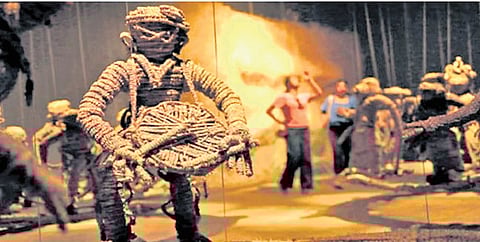

KOCHI: Seeking to enliven interest among global audiences, the sixth edition of the Kochi-Muziris Biennale (KMB) will feature an absorbing spectrum of activities, ranging from conversations and workshops to films, theatre, food, music, and choreographies, alongside the exhibitions.
Spanning over 109 days, the engagements have been drawn up by a team under Mario D’Souza, director of programmes, Kochi Biennale Foundation (KBF). The programmes will unfold along with the artworks curated by Nikhil Chopra with HH Art Spaces, Goa. KMB is set to open on December 12 and run through March 31, 2026.
D’Souza said thinking with people in today’s “fractured, polarised” world was a gift. “It is important to find joy, share a meal, grieve, and come to terms with loss. Resilience, in the face of adversity and forms of systemic erasure, is one of humanity’s greatest strengths. We honour caregivers and those who keep hope alive in our broken world,” he said.
The Biennale Pavilion, which will host the events, has been named ‘Primordial’. Built by architect Senthil Kumar Doss, the Pavilion “is the beating heart of the Biennale, activated by gatherings, events, and happenings’’, according to KBF.
A section, titled ‘Invitations’ and initiated in 2022 in the post-pandemic landscape, will continue with its aim: “Think with and learn from independent, artist-run initiatives, and public exhibitions from the southern, majoritarian world.”
This year’s contributors include Dar Yusuf Nasri Jacir for Art and Research (Palestine), Alice Yard (Trinidad and Tobago), Alkazi Theatre Archives, in collaboration with Alkazi Collection of Photography (India), Bienal das Amazônias (Brazil), Ghetto Biennale (Haiti), Khoj International Artists’ Association (India), Nairobi Contemporary Art Institute (Kenya), Packet (Sri Lanka) and ruangrupa/Gudskul (Jakarta).
The Pavilion programmes include ‘Nothing will remain other than the thorn lodged in the throat of this world’, a lecture-performance by Noor Abed and Haig Aivazian; a presentation of Somnath Waghmare’s documentary practice; and ‘Imagining Zomia’, a conversation with filmmakers, historians, and artists to re-examine the highlands of central, south, and southeast Asia; and ‘History of Long Durational Performances and MAI’, by Marina Abramovi