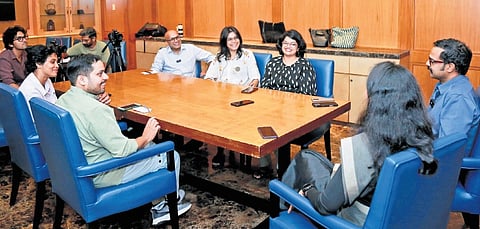

Ajeetha Begum Sulthan and Satheesh Bino make a rare police couple. Both are from the same 2008 IPS batch, and currently serve in the same rank in Kerala.
While Satheesh of Vaduthala in Kochi is deputy inspector-general for the Ernakulam Range, Ajeetha, who hails from Coimbatore, holds the same charge in Thiruvananthapuram.
Notably, the two are also devoted fitness enthusiasts and earned time in the limelight beyond their duties by successfully completing an Ironman triathlon.
Here, in a free-wheeling chat with TNIE, they open up about their police training, law & order in Kerala, gender bias in the force, personal victories and motivations that shape their journey, both in service and in life. Excerpts
How did you each find your way into the IPS?
Ajeetha Begum: I came from a background where girls were expected to get married by 18. My sister did too, after her first year of college. I was active in student politics and my professors encouraged me to study further. My parents, meanwhile, were planning my marriage. It took a couple of small ‘dharnas’ at home to convince them.
Later, my father then suggested I try for the civil services exam. I didn’t even know what that meant. But I gave it a shot, cleared it, and that’s how it began. IPS was my second choice, and I got it again when I wrote the exam a second time. So, it wasn’t my childhood dream per say, but I grew to love the uniform and the work.

Satheesh Bino: It was the opposite for me. My parents were fully supportive from the start. My father had once tried for the exam himself, and a cousin was already in the IPS. The atmosphere at home naturally drew me in.
You’re both from very different upbringings. How do those differences play out as you began this career?
Ajeetha: Whatever background you come from, the National Police Academy evens it out. Every year, 150 new IPS probationers would come in — from business families to children of daily wage earners. The training process makes everyone equal. The academy has a huge rock at the entrance that says every trainee is a raw stone, and the academy’s job is to sculpt them into a statue. And it really does.
Coming to your current roles, drug use has become a major issue in Kerala. How do we tackle this menace?
Satheesh: If we look at Kerala, we see a high number of NDPS cases, but 90 per cent involve small quantities. In some other states, there are fewer cases, but larger quantities are seized. So we have to look at it in totality. The police here are proactive. We have been conducting special drives under a programme called D-Hunt.
Ajeetha: Another thing to understand is that in Kerala, FIRs are more frequently registered. If it’s a cognisable crime, anyone can walk into a police station, file a case and leave. There’s no recommendation required. That’s not possible in many other states. So our crime statistics appear higher, including NDPS numbers. It doesn’t mean drug use is more widespread here.
Are you saying Kerala is at the top in policing?
Satheesh: Definitely. Kerala consistently ranks among the best in national surveys.
NDPS cases have evolved — earlier it was mostly ganja, but now there’s more MDMA and synthetic drugs. What’s driving that?
Ajeetha: Drug availability has definitely increased. But that’s not unique to Kerala, it’s true for most major cities across India and abroad. In Kerala, supply routes are diverse. Tracking is harder now. People with no prior record — youngsters, professionals, techies — are involved in trafficking or selling.
Satheesh: There’s also a larger question of balance. How much can police intrude into someone’s privacy? If I am investigating a drug case, can I access your phone, your parcel, your home? We have to respect citizens’ privacy while still enforcing the law. Within those limits, we are finding new and lawful ways to act.
Has the police ramped up their mechanisms to counter the new drug trends?
Ajeetha: Unlike alcohol, drug use is harder to detect. There’s no quick test yet. But research is underway. Soon, with the help of mass spectrometry-based machines, we will be able to detect drug use using a simple band-aid-like strip. It can detect traces even after 24 hours since consumption. That’s going to be a real game-changer.
What are your views on the influence of drugs and violence in cinema?
Satheesh: Cinema is a powerful influencer. It shows both the good and the bad because that’s what storytelling demands. If filmmakers only showed the good, there would be no story. The point is to watch wisely.
Ajeetha: Unfortunately, many people take inspiration from films in the wrong way. After Drishyam, we started seeing real-life ‘Drishyam model’ cases. But such films only influence those who already have certain behavioural issues.
I strongly oppose the glorification of violence. That’s what harms youngsters the most.
Another worrying crime on the rise is child pornography…
Satheesh: That’s a common perception. The numbers in Kerala might seem higher because we actively check and record statistics.
Ajeetha: Under the P-Hunt operation, we act on reports from the National Center for Missing and Exploited Children. These are handled by the Cyber Crime Special Cell within Kerala Police. They analyse the data, identify IP addresses involved in viewing, storing, or transferring child sexual exploitation material, and circulate the information to all districts. Based on this, we conduct regular raids — almost daily.
Satheesh: In Kerala, none of these reports goes to waste. Every piece of intelligence is acted upon. The follow-up is centralised and consistent.
Ajeetha: Kerala also records a high number of POCSO cases, but that doesn’t mean the crimes are more frequent here. Child sexual abuse is widespread everywhere. What’s different is that people in Kerala come forward to report it. That reflects awareness.
A few years ago, there was a perception that the police force was under stress and its reputation was declining. What are your thoughts?
Ajeetha: I actually researched this topic — about 9,000 officers participated in the survey. Interestingly, the third biggest source of stress was the negative public perception of the police.
Police officers do hundreds of good things for society every day, but one or two negative incidents get amplified. Moreover, people often associate the word ‘police’ with violence. That’s not right.
Satheesh: Exactly. Violence gets all the publicity, but that’s just one side of the story. Countless positive stories go unnoticed. In our state alone, there are around 500 police stations and thousands of officers interacting with the public every day. Considering that scale, the number of misconduct is extremely low. And when something does happen, we handle it strictly. There’s a lot of transparency now.
In cities like Kochi, there’s an allegation that police officers assume anyone out late at night must be up to no good. How do you see that?
Satheesh: It’s a complicated issue. Police officers are trained to look for antisocial activity during night patrols. Over time, that conditioning strengthens. They become sharper, but it can also create bias. The public shouldn’t generalise that vigilance into a cultural judgement. It’s just part of the job, not a moral stance.
Ajeetha: Some of that perception came from a few viral videos. To counter it, there needs to be a stronger narrative around a healthy nightlife. Maybe citizen collectives can help lead that shift.
On the other side, some officers say they are scared to approach strangers at night, worried the person might turn violent….
Satheesh: There are definite risks. We have standard procedures for different scenarios. Training teaches us how to approach, when to engage, and what’s legally allowed. These things are drilled into us.
Ajeetha: Many officers don’t regularly practise unarmed combat. It’s vital to keep up physical training. The DGP recently directed that officers should train in some form of martial art once or twice a week at the station level.
There are reports of externed individuals under KAAPA causing trouble in other districts. Are there checks in place?
Satheesh: Yes, we monitor that closely. Our systems store details of all such individuals. We can instantly identify someone by scanning their photo using our mobile phones. Earlier, officers relied on personal familiarity. Now everything’s digital. Persistent defiance can lead to imprisonment.
What’s your (Ajeetha) assessment of the rise of unusual crimes and reports of gang activity in Thiruvananthapuram rural areas?
Ajeetha: There haven’t been any major gang wars recently, but there have been several disturbing cases, including the murder of a two-and-a-half-year-old child, the Gopanswamy case, and the mass killing of a five-member family.
The Thiruvananthapuram Range covers Thiruvananthapuram Rural, Kollam City, Kollam Rural, and Pathanamthitta districts. Thiruvananthapuram Rural records the most complaints: one issue fades and another surfaces almost immediately. In Kollam City, organised gang attacks have also been reported, including a recent murder in the Karunagappally subdivision. Cases like these keep me extremely busy.
‘We keep pushing each other...’
(To Ajeetha) What are the other charges you hold?
Ajeetha: I am currently director of social policing. Across Kerala, we run the Janamaithri Suraksha Project and the Student Police Cadet (SPC) programme, as well as initiatives like HOPE for students who have failed academically, and Prasanthi for senior citizens.
HOPE is particularly close to me. It supports students who failed their Class 10 or Class 12 exams, or dropped out. We enroll them, pay their tuition fees, and help them return to education. Over 4,200 students have benefited so far.
I also serve as the State Nodal Officer for Women and Children.
The SPC is commendable…
Ajeetha: It trains 8th and 9th standard students in 1,048 schools — over 80,000 cadets. The police force has 60,000 officers, but there are 3.5 lakh SPC alumni across Kerala. Recently, a girl from Kattappana — once an SPC cadet — cracked the Civil Services exam.
Do women still hesitate to approach the police in cases of domestic violence or sexual harassment?
Ajeetha: Yes, to be honest. Many fear breaking the family structure or causing embarrassment. Most are financially dependent on their abuser.
Moreover, many officers still advise complainants to go directly to court instead of filing a case at the station. This happens due to bias, habit, or work pressure. This mindset needs to change.
What’s being done to strengthen enforcement of the Domestic Violence Act?
Ajeetha: We have proposed a new system to the DGP, and he’s approved it. Every court-issued protection order goes to the local police station, but most are just filed away. In Thiruvananthapuram alone, there are about 600 orders a year. Now, each station will have a Women’s Safety SI and Vanitha Police officers as victim support officers. They will call or visit the woman to check on her safety. Kerala Police already runs counselling initiatives and de-addiction centres, and these will now work together to offer better support.
What about bias formation within the police?
Satheesh: It’s one of my subjects of study. Biases are subtle but pervasive. For example, if a man reports that his daughter is missing, an officer might immediately ask if she had a boyfriend. Or, in an accident between a bus and a bicycle, officers might assume the bus is at fault — a ‘big vehicle syndrome’.
Evidence should always outweigh experience, yet many people, including officers, tend to rely on experience alone. We are now addressing it through formal training modules on bias awareness and ethical policing.
How much has women’s representation grown in the police?
Ajeetha: When I joined, women made up only 5 per cent of the Kerala Police. Now women make up 11 per cent of the Kerala Police. Nationally, the goal is 30 per cent. The more women we have in the department, the more balanced and empathetic the system becomes. And someday, when recruitment at the constable level fully opens up, I wouldn’t be surprised if we end up having reservation for men (laughs)!
Are women officers still seen as vulnerable within the force?
Ajeetha: Not really. Those assumptions have faded.
Satheesh: Biases still exist in society. These biases can seep in within the force, which is an extension of this community. But we have built mechanisms to deal with them.
(To Ajeetha) What were the challenges you faced as a woman officer in your initial days?
Ajeetha: Not much. As ASPs, we had authority. Perhaps for women constables, the environment might have been tougher, but for officers, it was manageable. But yes, in remote stations, people were surprised to see a woman officer.
In Kerala, we have had many strong women officers. Sandhya, Sreelekha and Harshitha… they paved the way. Now, we have around 20 women IPS officers from our batch alone. Each new batch in the academy has about 50 women trainees, nearly a third of the intake. That’s a big leap.
But, of course, bias doesn’t vanish overnight. Once, when I was SP of Wayanad, someone called late at night asking for the SP. When I said, I am the SP, he paused and then said, ‘Please give the phone to the SP.’ He probably thought I was the SP’s wife (laughs)!
Also, there’s still discomfort in taking orders from women. Once, an officer told me, ‘Madam, shout at me only after others leave.’ These attitudes exist, but they are fading.
You (Ajeetha) were part of the Hema Committee investigation. What’s the current status?
Ajeetha: It hasn’t been shelved. The SIT was formed to handle cognisable offences flagged by the committee. Those cases have been investigated, and reports submitted to court.
Though the SIT has completed its work, new complaints can still be filed at any police station or directly with the district police chief. There’s no vacuum in enforcement.
[To Satheesh] You often credit your father’s influence in life…
Satheesh: Definitely. Parents shape how we see the world. My father, a senior scientist at CMFRI, wanted me in the civil services. His curiosity and discipline rubbed off on me.
And you, Ajeetha, who influenced you most?
Satheesh: Other than me… (laughs)!
Ajeetha: (laughs) Yes, Satheesh does have a big influence on me now. But there are also others — my parents, sister, friends and teachers. My father studied only till Class 2, but he’s an exceptionally rational man who reads everything he can find.
As a child, I would listen to him narrate stories from books he would read. He once had to visit the Coimbatore Collectorate daily for four months for a certificate as he refused to bribe anyone. That experience stuck with him, and he wanted his daughter to become an IAS officer.
Satheesh: Both our fathers share that same quiet pride. They visit our offices, sit at the back, and leave with a smile. That’s their favourite pastime now.
Ajeetha: My mother, meanwhile, is deeply traditional. When I got into the IPS, her biggest worry was that I would have to wear trousers (laughs)! After six months of academy training, I went home in jeans and a T-shirt — she was stunned. Over time, she’s come around.
Being in the same profession, do egos ever clash?
Satheesh: They used to (laughs). Big ones. But over time, we realised it’s pointless. The job itself demands teamwork.
Ajeetha: True. Small disagreements happen, but there’s zero ego professionally. We learn from each other. I learn a lot from him, and sometimes, he learns from me too.
Satheesh: I am grateful that she said that on record — evidence duly noted. (Both laugh)
Ajeetha: When I joined, I had just a BCom degree; he already had a PhD. He would tease me about it. So I went on to do an MA, then an Advanced Master’s in Public Policy, and later the Humphrey Fellowship in the US — which he also did later (laughs)!
We keep pushing each other that way. He’s been a motivation for me, and sometimes, I have been an inspiration for him.
Satheesh: Our career graphs look almost identical — same academy, similar postings, same fellowship. The difference is in focus: she leans towards community and child rights, I towards training and human rights. But the foundation is shared.
Both of you have a passion for endurance sports…
Satheesh: Yes. From 2018 to 2022, we were back at the academy — as trainers. Shortly after we joined, Covid hit and so, training went online. We had unexpected free time on the campus. That’s when we started triathlon training. Just as a hobby at first.
That hobby turned into completing Ironman races… what was that journey like?
Satheesh: Our first attempt was in Spain. We finished the 3.8km swim, but Ajeetha had a small accident early in the 180km cycling leg. There was no way she could complete the race. Later, as I was cycling, the stretch became very mountainous and the weather very hot. I was struggling to continue. So, I decided to skip the race.
Ajeetha: Next year, we decided to give it another go. In Maryland. Though I could complete it, Satheesh couldn't. And because of that, we enrolled for another race the following year. In Texas. Both Satheesh and I finished this. My second, and his first.
The race involved 3.8km swimming, 180km cycling and a full marathon — all within 17 hours. It’s as much mental as physical.
Are you planning another triathlon?
Ajeetha: Not soon. These need months of preparation — weekends are a luxury now. But Ironman did leave a deep mark. It changed how we viewed health. We now focus on being healthy, not just fit.
Satheesh: Motivation fades, but discipline stays. It’s less about physical strength, more about training your mind to listen.
Team TNIE: Abdul Nazer M A, Krishna P S, Ronnie Kuriakose, Supriya, Varsha Somaraj, (video) Harikrishna B and Pranav V B, (photos) T P Sooraj