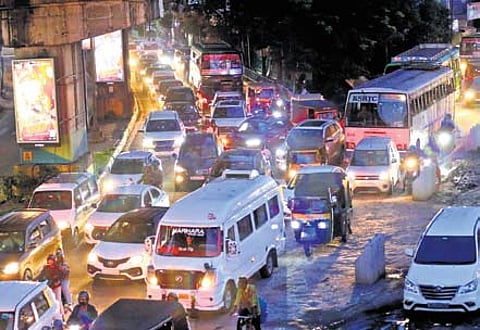

KOCHI: For many Kochi commuters, getting from one end of the city to another has become an arduous task. Indeed, with metro construction, utility work and road repair unfolding simultaneously across several arterial roads, peak-hour traffic in the city has invariably slowed to a crawl.
The impact is most visible along the Banerji Road, a key arterial link in the city, especially its JLN Stadium-Palarivattom stretch, where metro construction has narrowed the road width. Similar bottlenecks are being reported at Edappally, Vyttila, Kadavanthra and Kaloor junctions. Together, these four make up the prominent crossroads that anchor the city’s traffic.
The stress on these locations has spilt onto smaller bylanes cutting through what are otherwise residential neighbourhoods. However, taking these alternative routes offers little or no relief to motorists, as these too are dug up for works by agencies such as KWA and KSEB.
“The problem is not just the number of projects being undertaken simultaneously, but the lack of coordination between departments. Roads restored after utility work are often left uneven for weeks, while fresh excavation begins on stretches that were only recently repaired,” said K P Sreevalsan, a commuter.
Another commuter, Georgian Alex, questioned the logic behind these public utility agencies carrying out essential work during the monsoon.
“What’s the point of that? In the summer, when these works could have been carried out seamlessly and with a fraction of the difficulty, officials cited the model code of conduct concerning the elections as an excuse to defer or delay the work.
Now, what they have done is only create more chaos. Public money might as well be thrown into the Vembanad Lake, because that’s essentially what is happening here,” she said.
“Riding a scooter has become genuinely risky,” said Appu, a public transit and pedestrian infrastructure enthusiast who actively flags traffic issues via social media.
“When it rains, the slush and uneven road surface make it difficult to judge potholes or bumps. At night, it’s worse because you can’t always see what’s ahead. Every ride is stressful,” he added.
He also said that the poor quality of temporary restoration has become a recurring issue.
“They pour concrete after digging up the road, but don’t level it properly. The result is a series of undulations that are dangerous for two-wheelers. Even the diversion roads suggested during metro work have been dug up in some places.”
While those travelling in cars are less exposed to safety risks, they too bear the cost of prolonged congestion.
“We are wasting so many hours in this slow-moving traffic. Fuel bills are already up because of the war (in West Asia). But to be on our roads, in the state they are in, means we are burning a lot of fuel, and with it, a lot of money, to get nowhere really. The other day, I spent nearly an hour on the highway near Edappally,” said Varghese, a resident. “It’s frustrating to sit through the same traffic jam every day,” said Soumya Chandran, who works at Infopark.
“The lack of a really effective public transport ecosystem in Kochi comes to the fore during the monsoons, when every road in the city has kilometres-long queues,” she added.
Residents and motorists say the city needs better coordination among executing agencies so that multiple projects are not undertaken on adjoining roads simultaneously. They also want roads to be restored quickly and properly after excavation instead of leaving commuters to deal with damaged surfaces for weeks. With the monsoon adding another layer of difficulty, many fear that Kochi’s rush-hour gridlock will only worsen in the coming weeks.
