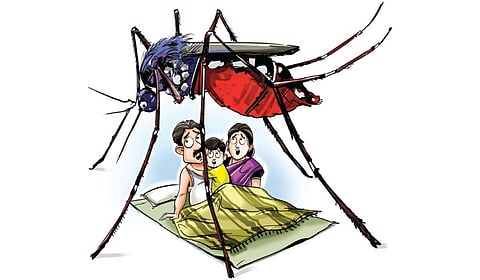

KOCHI: As intermittent monsoon rain continues, Ernakulam district is witnessing a sharp increase in the number of dengue cases, with 206 confirmed cases reported in the first 10 days of July alone. The district has recorded 463 suspected cases so far this month, prompting the district health department to intensify preventive measures against mosquito breeding.
In June, the district reported 841 suspected and 319 confirmed cases. According to Dr Rajeev Jayadevan, the convener of the Indian Medical Association (IMA) Research Cell, the surge in the number of cases was an expected phenomenon.
“Dengue-transmitting mosquitoes are active in the monsoon season, and several dengue cases are being reported across the state. This combination heightens the risk of disease transmission, making prevention challenging. We need to focus on sustained mosquito control, especially in crowded areas,” he said.
The vector-borne disease -- caused by Aedes aegypti mosquitoes and four distinct, closely related serotypes of the dengue virus (DENV-1, DENV-2, DENV-3, and DENV-4) -- can spread easily during the monsoon.
Dr Rajeev added that a second infection of the dengue virus can turn dangerous.

“With four serotypes circulating, the chances of getting a second infection of dengue are high. Many first infections may go undiagnosed, as symptoms can be mild or even absent. However, a subsequent infection with a different serotype can increase the risk of severe disease. Thus, recurrence should be avoided. Year-round anti-mosquito measures should also be implemented,” he emphasised.
The health department has also been observing dry days, and door-to-door campaigns have been launched to raise awareness.
The district medical officer has said that source destruction activities will continue every Friday in schools, every Saturday in offices, and every Sunday in households.
According to Dr Rajeev, awareness and public participation play a crucial role in tackling the situation.
“The public is not always aware of the exact significance of observing ‘dry days’. Once a week, we need to ensure that there is no stagnant water in our surroundings so that mosquitoes can’t lay more eggs. The cooperation of the public, local self-governments, and health departments remains crucial in eradicating mosquitoes and preventing the spread of dengue,” he added.