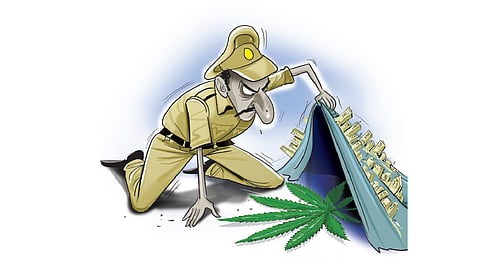

KOCHI: Trusted customers, frequently altered mobile phones, rotating couriers and small supply groups have replaced open street-level drug dealing in Ernakulam as syndicates adapt to the state police’s relentless crackdown under Operation Toofan, turning the once-visible trade into a secretive and constantly changing underground operation.
Since the launch of the operation, field visits by TNIE to migrant-worker hubs in Perumbavoor, Aluva, Angamaly and parts of Kochi, coupled with conversations with migrant workers and senior police officers, indicate that traffickers have moved away from conventional street-level peddling and taken to small, independent groups handling specific roles in the supply chain.
“If somebody asks for drugs, the first question is who sent him. They don’t deal with unknown people anymore. They are concerned that every new customer could be a cop,” said Sanjay Nayak, a 30-year-old construction worker from Odisha.
A senior officer said organised syndicates have become increasingly decentralised, with members handling only specific tasks.
“Every member performs only a specific role. One person identifies customers, another coordinates the supply, another transports the narcotics, while others handle communication. This limits the information available if any one person is arrested,” the officer said.
A factory worker from Assam, Rafiqul Islam, said Operation Toofan has changed the structure of the trade. “Earlier, everyone knew who the peddler was. One person supplied many workers. Now different people handle different groups. Even if police catch one person, he doesn’t know much about the others,” he said.
Another worker from West Bengal, Subhajit Das said traffickers have become almost invisible. “They don’t visit labour camps regularly anymore. They keep changing the person who contacts us. Even the phone numbers change frequently. They don’t want anyone to recognise a pattern,” said Subhajit, who works at a plywood unit near Perumbavoor.
Investigators said traffickers have shifted to micro-distribution, avoiding the storage of large quantities and moving drugs only after receiving confirmed demand. This has reduced the possibility of major seizures during surprise inspections.
Officers said traffickers frequently replace low-cost mobile phones and SIM cards, while key suppliers and financiers operate away from the district, making it difficult to identify the people controlling the trade.
“The crackdown has certainly increased risks for traffickers. But every enforcement drive forces criminal networks to adapt. Our focus is therefore shifting beyond peddlers to the people financing the trade, coordinating interstate supplies and recruiting new distributors. That is where the investigation is headed,” the officer said.
Police have intensified surveillance around labour colonies, transport hubs and other vulnerable locations while analysing financial transactions, communication patterns and interstate links to identify the higher-level operators.
“People are afraid now. Nobody talks openly about drugs like before. Everything is done quietly through people who already know each other,” said Pradeep Nayak, another migrant worker from Odisha.
Modus operandi change
Trusted customers only: Traffickers now avoid strangers and rely on referrals from existing users.
Small independent groups: Different people handle customers, transport and supply, limiting information available to police.
Frequent phone changes: Runners regularly replace mobile phones and SIM cards to make tracking difficult.
Micro-distribution: Operatives carry only small quantities and move drugs after receiving confirmed demand.
