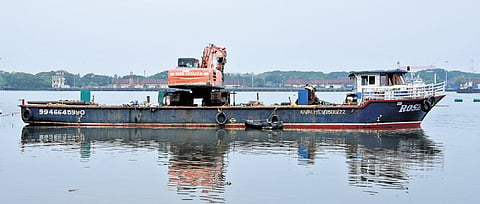

KOCHI: The persistent siltation in Kochi’s waterways has come to plague the operations of several inland navigation agencies, most notably the State Water Transport Department (SWTD) and the Kerala Shipping and Inland Navigation Corporation (KSINC).
A SWTD official said the department was unable to sustain its Kochi-Vaikom service after vessels repeatedly ran aground on poorly dredged stretches. “The dredging was not proper. There were grounding issues, and we were taking a risk operating the service,” he said. “Ultimately, we had to pull our tourism boat Indira from Kochi’s waters.”
The same has since been redeployed to Alappuzha, where it now operates the department’s Kuttanad safari package. “The move has turned out to be a big boon for us,” the official highlighted. Indeed, the vessel raked in around `25 lakh in revenue in just two months.
Buoyed by this, SWTD is considering deploying their upcoming six solar boats in Alappuzha, instead of Kochi. “Though we are also considering Kadamakkudy for potential deployment, Alappuzha is the frontrunner. After all, everything hinges on navigability,” the official said.
Meanwhile, KSINC, which operates sea and backwater cruises in Kochi, has also been forced to adapt.
“Dredging activities in Kochi remain confined to navy and shipping channels. Despite being the face of Kochi, the Marine Drive waterfront is debilitated with silt accumulation, and vessel operations from here are rendered difficult, especially during low tide,” a KSINC official said.
This was one of the primary reasons that prompted the agency to construct a new jetty along the city’s southern waterfront, where regular dredging undertaken for naval and crude oil mother barges ensures better navigability.

However, to salvage their operations in Marine Drive, which remains a key boarding point for tourist and leisure cruises, the agency has, as TNIE had reported earlier, allocated `1.95 crore for a new pontoon or floating jetty.
“We have also been engaging private agencies to periodically remove the accumulated silt in our channel. Even then, delays and, sometimes, cancellations occur. Hence, the new pontoon and the new jetty,” the KSINC official said.
For private-tourism operators on the Marine Drive waterfront, who cannot move to a new jetty or set up a pontoon, the matter is even more grievous. It’s not tourism vessels alone that are affected. Earlier this year, regular passenger ferry services to and from Mattancherry were disrupted.
On contacting the Cochin Port Authority (CPT), TNIE learned that their dredging mandate is limited to Kochi’s wharfs and terminals and the shipping channels that lead to them.
“We take care of the berth, basic and operational draft clearances across Ernakulam and Mattancherry wharfs, the cruise terminal, the Cochin Oil Terminal and North Tanker Berth and the Vallarpadam International Container Transshipment Terminal. That’s all,” a CPT official said.He also emphasised that dredging activities in the eastern waters of Vembanad Lake do not come under their purview. And it is here that the siltation is more pronounced. But over time, they come to haunt the city’s waterfronts as well.
Vembanad connection
Scientists pointed out that this persistent accumulation of silt is a symptom of a much larger ecological problem affecting the Vembanad Lake system. According to S Bijoy Nandan, dean of the faculty of marine sciences at Cochin University of Science and Technology (Cusat), the recurring siltation in Kochi’s waterways is the result of decades of hydrological changes, land reclamation and heavy ‘ekkal’ (silt and sediment) deposition.
A report by him, accessed by TNIE, pins the problem partly on the Thanneermukkom Bund. It says the structure has reduced tidal flushing in the southern part of the lake, encouraging the accumulation of organic matter and debris, while monsoon-fed rivers continue to carry nearly 32 million tonnes of sediment into the system annually.
Data reveals that the mean depth of the Vembanad has reduced drastically over the decades, with the southern region of the Thannermukkom barrage shrinking from 8-9 metres in 1930 to about 1.8 metres, while depths north of the barrage, towards Kochi, have declined from 9-13 metres to around 3 metres.
“The resulting loss of depth has affected navigation, fisheries, tourism, flood-carrying capacity and the overall ecological health of the lake,” the report said. Among the affected areas it lists are Kochi, Kumbalangi, Chellanam, Perumpadappu, Palluruthy, Mattancherry, Kallancherry, Kumbalam, Edakochi, Aroor, Perambalam, Udayamperoor and Vaikom.
The report also notes that there is a heavy risk from ‘ekkal’ in and around Kochi harbour, which also adversely affects its operation. With Kerala increasingly banking on inland waterways for public transport and tourism, agencies say maintaining navigable channels through sustained dredging will be critical to ensuring the long-term viability of water transport in Kochi.