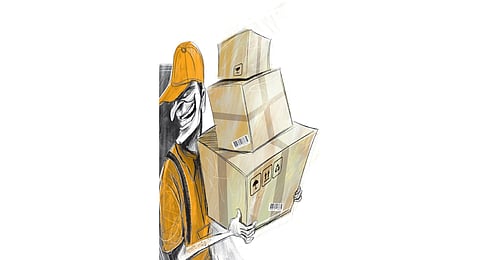

KOCHI: It was supposed to be a routine e-commerce delivery. The agent was familiar, having handled the elderly couple’s previous online orders.
“But I told him that we had not ordered anything,” said the wife, to whom the package was addressed. “My name was on the parcel, and the slip described the item as a face mask. But since I had not placed the order, I refused to accept or open the package.”
To take back the parcel, the agent sought an OTP number he said had been sent to the presumptive recipient’s phone. After the OTP was shared, the parcel was returned.
“This was just the first such instance,” the wife said. A few days later, another individual arrived with a similar parcel. The Kaloor couple refused to accept the unsolicited parcel.
They also started receiving calls from numbers registered in Ahmedabad, Delhi and Bhopal. “I did not answer any of them,” the husband said.
There were two more such delivery attempts. “Every time I quizzed those delivering the parcels on their origin, they simply replied that they had been instructed to deliver them and that they did not know anything further,” the wife said.
“All of them appeared to be cash-on-delivery (COD) orders, and I was concerned about having to make a payment if I accepted or opened them,” she added.
According to Ankit Asokan, SP of cyber operations with Kerala police, this resembles a known fraud tactic involving unsolicited COD parcels.
“This appears to be a modus operandi employed by fraudsters. The scammers get hold of addresses and phone numbers and send low-value items, old clothes, bricks, or other worthless products. If a recipient accepts a parcel and makes the payment, the money is lost. In some cases, repeated deliveries may be attempted.
Delivery personnel are often unaware of the fraud, as payments are collected either in cash or through QR-code transactions and passed through the normal delivery process,” Ankit said.
It is important that people maintain a separate bank account for online transactions, he said.
“One account should be reserved for salary deposits, savings, loans and other important financial activities, with no online transactions enabled. A second account should be used for online transactions. Only transfer money into that account when needed and use it for digital payments,” the officer said.
Delivery agents, meanwhile, say they too face difficulties due to the repeat parcel deliveries. An agent, who requested anonymity, said several customers have reported similar experiences. “When customers provide the OTP, we receive an incentive of around `10, on top of the usual `16 compensation.
Some customers, on receiving repeated deliveries, even block our phone numbers. But we don’t really have an option because once the parcel reaches the courier hub, we are expected to attempt delivery,” he said.
TNIE had recently reported a newfangled mode involving traffickers using unsuspecting homes, shops and workshops in the city as covert collection points for narcotics shipped through courier services, a illicit tactic police said is gaining traction.
Modus operandi
The scammers get hold of addresses and phone numbers of people and send low-value items to them
If a recipient accepts a parcel and makes the payment, the money is lost
Delivery personnel are often unaware of the fraud, as payments are collected either in cash or through QR-code transactions and passed through the normal delivery process
