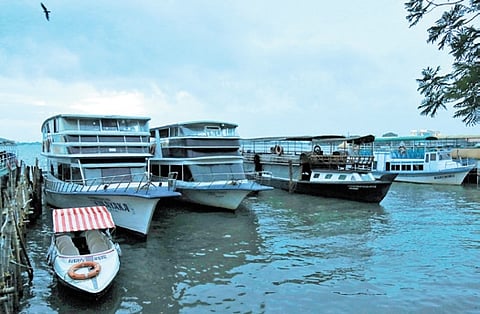

KOCHI: Private tourist boat operators in Ernakulam have reported a 40% decline in business over the past two years as competition from the water metro, falling tourist footfall and regulatory concerns threaten their operations.
Around 180 private boats currently operate from Marine Drive. Nearly 15 operators have shifted base to the Malabar region due to poor business, according to the Marine Drive Tourist Boat Association.
Operators estimate that nearly 20-22% of tourists visiting the district now opt for water metro services instead of private boats. They say this has intensified competition among the remaining operators.
Kochi Metro Passengers Forum member Ebenezer Chullikkad pointed out that water metro, which was conceived as a modern public transport alternative, now predominantly draws tourists. “Nearly 90% of its passengers are tourists. The Ernakulam-Fort Kochi route, its busiest stretch, also sees a high concentration of tourists.
The impact extends beyond boat owners to workers. Hundreds of employees and their families rely on private tourist boat services for their livelihood. Those who have invested in boats through loans are also struggling to meet repayments and maintenance expenses as passenger numbers fall,” said Ebenezer.
“This has also led to unhealthy competition among private operators,” said Saju T B, secretary of the association who owns four boats.
The decline in tourist arrivals has further affected business. The West Asia conflict has reduced the number of families travelling from the Malabar region to Ernakulam, they say. Changes in travel patterns have also affected pilgrim traffic. Earlier, Sabarimala pilgrims often visited Ernakulam Shiva temple and Chottanikkara on their way to the Sabarimala temple. Improved highway connectivity has made direct travel easier and reduced such stopovers, Saju said.
Meanwhile, operators are concerned about the implementation of the Inland Vessels (IV) Act. They fear that regulations designed for larger vessels could be imposed on smaller tourist boats as well. This could reduce passenger capacity and make operations financially unviable. Traditional wooden boats and local services could also face restrictions. “The rules cannot be the same for every type of vessel.
Small tourist boats have different operating conditions from larger vessels. If the same standards are imposed on all, many local operators will find it difficult to survive. The regulations should take regional needs and the nature of the vessels into account,” opined Saju.
The shortage of experienced crew members is another concern. Though the Maritime Board conducts training and licensing programmes, operators say practical skills are becoming harder to find as younger people move towards jobs in organised and automated transport services. The association plans to approach the court and meet the chief minister to seek region-specific regulations and protection for traditional boat services.
Factors affecting biz
Competition from the water metro, falling tourist footfall and regulatory concerns threatening operations
Operators estimate that nearly 20-22% of tourists visiting the district now opt for water metro
Decline in tourist arrivals has further affected business
