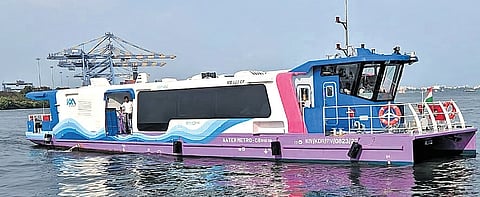

KOCHI: Kochi Water Metro was designed to earn 60% of its revenue from sources other than passenger fares. But the project is now earning just 4 to 5% from such sources. The gap between the original vision and the reality has come into focus after the government asked the Kochi Water Metro Limited (KWML) to find ways to generate revenue on its own.
It was originally decided to have commercial development at 18 major terminals. The plan was to acquire around one acre at each major station to accommodate commercial facilities. That did not happen.
“Fort Kochi was supposed to have 20,000 sq ft of space but ended up with only 7,000 sq ft. Mattancherry was planned for 15,000 sq ft but has 6,600 sq ft. At the Ernakulam terminal, the planned 40,000 sq ft shrank to just 7,000 sq ft. This reduced the opportunities for commercial spaces,” a former KWML official told TNIE.
The problem is not limited to projects that never took off. A proposal to open a cafeteria at Fort Kochi has not moved forward. Kiosks at the High Court terminal are also unused despite officials saying the dispute with the corporation over an MoU and building numbers has been resolved.
The commercial setbacks come at a time when several terminals are yet to draw passenger traffic. Bolgatty, Cheranalloor and Eloor are among the stations reporting low footfall compared to a few major terminals. Adding to this comes the dropping of six terminals for various reasons.
The government has now allocated Rs 8.88 crore towards KWML’s operational expenses for 2026-27. It has also directed the agency to explore additional revenue sources and review ticket fares through an expert committee.
Sources formerly associated with the project said higher ticket prices could push passengers away from the service.
“The immediate priority should therefore be to make existing commercial opportunities work rather than depend on fare hikes. Rental rates and conditions should be made more market-friendly to attract businesses and put available space to use,” an expert said.
Meanwhile, Kochi Metro passengers forum representatives argue that the primary obligation for sustaining a public transport system continues to rest with the state and if the government intends to redefine Water Metro as a self-financing or profit-oriented enterprise, such a change should emerge through an explicit government policy debated in the legislative assembly, rather than through an administrative office memorandum.
