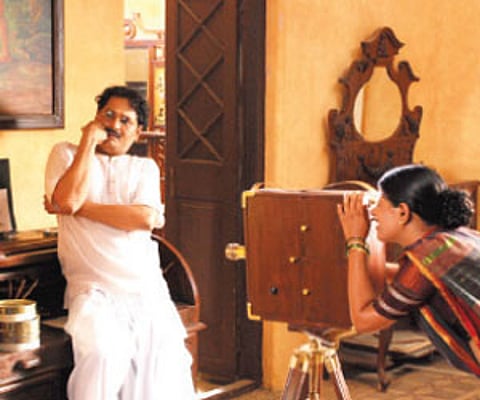

DADA ARJUNA PHALKE
What was it that Dada Saheb Phalke saw in moving pictures that made him risk everything, his wealth and his health, to make India’s first silent film? Or to put it better, how was it that moving pictures revealed itself to Dada Saheb Phalke?
Paresh Mokashi’s Marathi biopic ‘Harishchandra’s Factory’, India’s official entry to the Oscars, does not provide an answer. The film provides a mere outline. Some visuals of bull fighting, according to Mokashi’s film, are the first moving images Dada Saheb Phalke saw. The second set of images related to the life of Jesus Christ.
Other Indians in 1911 had seen the very same images but it was only Phalke who thought of making a moving picture. So these pictures definitely might have presented differently to Phalke. And how magical/spiritual the revelation was for Phalke, Paresh Mokashi does not say.
To get a clear idea of what the Marathi filmmaker has missed to convey, let us take an episode from the Mahabharata epic, say the start of the Kurukshetra war. Now, if we are to ask Mokashi to tell the story, he would probably do it this way.
‘‘The Pandavas and Kauravas are lined up for the war. The fighting could begin any moment. Arjuna is feeling weak. His arrow feels unusually heavy.
He can’t bear the thought of fighting his loved ones. So his charioteer Krishna pulls him out of the chariot and talks to him in private. After Krishna’s pep talk Arjuna looks refreshed, gets back into his chariot and screams charge.’’
At this point you might be tempted to ask: ‘‘But Mokashi, where is the Bhagavad Gita? We were told that while talking in private the Lord had revealed his true self to Arjuna, revealed eternal truths.’’ After watching ‘Harishchandra’s Factory’, one would perhaps ask the same. ‘‘But Mokashi, what were the secrets moving pictures revealed to Dada Saheb Phalke when it pulled him out of the crowd and communicated in private? You failed to mention about the Bhagavad Gita of moving pictures.’’
THE SEQUEL
In a sense Wanuri Kahiu’s Kenyan film ‘From a Whisper’ is a sequel to Atil Inac’s Turkish feature ‘A Step Into the Darkness’. If Atil’s film is about events that eerily lead to the making of a suicide bomber, Kahiu’s is about picking up the pieces after a suicide bomb blast.
In ‘A Step Into the Darkness’, the act of stepping out to bomb the US Embassy in Turkey is the culmination, the end result, of all that had happened in the film. In ‘From a Whisper’, the bombing of the US Embassy in Kenya is a memory that propels the film forward. (The bombing had taken place in 1998 and the film plays out in the present, in 2009.) One film’s denouement becomes the other’s backdrop.
In Atil’s film the bombing happens outside, in Kahiu’s it happens within. In one it is a spectacle, a sudden burst of flame in the Centre of Turkey. In the other it is a nightmare, a shattering thought that relentlessly appears in staccato bursts. If Atil’s film is about picking up the components of hatred to fabricate a bomb, ‘From a Whisper’ is about searching for shards of love in the burnt remains. If in ‘A Step Into the Darkness’ minds are farmed to cultivate anger, in Kahiu’s film minds are soothed to seek out love.
Terrorist vs Terrorist: The suicide bombers in the two films are a study in contrast. Cennat in ‘A Step Into the Darkness’ is a cultivated terrorist, a blighted one not properly nourished. Fareed in ‘From a Whisper’ is a natural, a born ‘jehadi’.
Cennat is a girl who has lost everything during an American raid in her village, her parents, her brothers, her sisters, her home. She is already dead. She is jehad’s prey. Fareed kills for the sake of killing, not because he has lost anyone. Jehad is his birthright. She goes out on her mission like a rose petal caught in a storm. He goes out on his mission like an energetic driver going out on his first assignment of the day. Cennat is like a blind person. She is led. Fareed is clear-sighted. He leads.
Fallen Mask: But Fareed still is human. Something happens while he is on his way to the US Embassy. There is a traffic hold up. A car pulls up at the side of his vehicle. From behind a little girl smiles, she shows him monkey faces. He turns his head away, as if suggesting he was least amused by the antics. He turns to look at the girl once again. The girl now displays a piece of paper on the car window. The paper has a crayon drawing of his van, in pink and green. He is also there in the drawing. A smile escapes his pursed lips. He turns away.
At that moment it seemed Fareed wanted to jump out of his van, open the door of the car, take the child out, embrace her, kiss her and hold on to her for eternity. But he didn’t. He goes ahead, kills himself and a hundred others.
A Question: Fareed in ‘From a Whisper’ is disturbingly sure of himself but a question asked by his best friend Abu leaves him utterly blank. Fareed says it is people like him who has true faith in Islam and are the chosen ones of God. Then Abu asks: “If God’s chosen ones keep taking their own lives then who will be left to save the world.’’ Fareed is stumped. He can only offer a sheepish grin.
CHE AND EVE
There is great drama in the martyrdom of man. But the martyrdom of woman is realistic, documentary-like.
Sample two moments from Elia Suleiman’s ‘The Time That Remains’. It is 1948. The Israeli army has just taken over Nazareth. The army has asked the Arabs living in Israel to surrender. The scene plays out in the courtyard of a temporary Israeli base. Surrendered Arabs on the far end. A collection of guns at the centre.
A top Israeli official is standing high up on the landing of a huge flight of stairs, his right leg raised over the edge, surveying the courtyard below like a proxy God. An Arab in a blue suit walks in, stands below the Israeli official and looks up. Dead silence. The man takes out a paper, pulls out his glasses and reads out a prepared statement, a defiant one which in short says he would die rather than submit to Israel. Saying this he takes out a gun and shoots himself dead.
Suleiman takes time and various angles to compose the sequence. He does it with great solemnity, almost as if he had his camera inside a church.
Now for the woman martyr. It is 1948. The Israeli army is marching through Nazareth. The camera is fixed, some distance away from the marching soldiers. Just as the soldiers cross a deserted road a woman runs towards the battallion from the right and curses them. The soldiers march as if they have not seen her, but one of them in the middle, without even looking at the woman, shoots her down.
All this happens in a matter of seconds. The camera takes its eyes off suddenly.
If the man’s martyrdom looked a bit pretentious, the woman’s looked real.
r_ayyappan@expressbuzz.com
