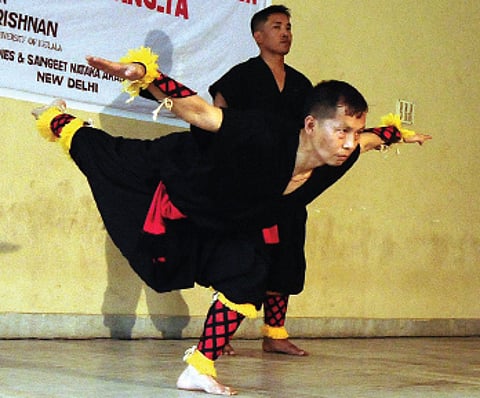

Thang-ta, the martial art of Manipur, is a dazzler. Its agility and pace dream-like, splashing resemblances to Kalaripayattu in many frames. Both martial arts have their roots steeped in tradition and rituals and in both a wrong step could mean the end. Yet both are as different as chalk and cheese.
Ranjeet Chingtham runs a Thang-ta training centre in Manipur. Initially into Kung Fu, the man later fell in love with the thang (sword) and ta (spear) art form at the age of 13 in early 1980. He immersed himself into learning the martial art and now heads Kanglei Shaktam Langba in Imphal. Ranjeet is in the land of Kalaripayattu for the first time, though the art form itself is not foreign to him.
At ‘Kerala meets Manipur’, a national seminar on Kalaripayyatu and Thang-ta organised by the International Centre for Kerala Studies (ICKS)on Kariavattom campus with the support of Sangeeth Natak Akademy, Ranjeet and his ten-member team had the audience hooked to their performance.
‘’It is a way of life. The exercises, movements and the fighting methods are all meaningful, meant to instill discipline, boost self-confidence, safeguard women, respect elders or fight for the kingdom. There are some animal movements which are same as in Kalari, yet the techniques are different. Thang-ta is not just about physical strength or agility it is also about mental strengthening,’’ he says. The reason why his ancestors who were experts in Thang-ta could read future from the moving clouds, he says.
In 1994, a team of Kalaripayattu performers had visited Manipur and Ranjeet had undertaken a study on the similarities and differences of the two art forms. While there are weapons like ‘arambai’ (a pointed small spear with traditional poison filled at the tip), ‘thang’ and ‘chungoi’ and many others which add power to Thang-ta as in Kalari, one major difference is that the spear (ta) used in Thang-ta is double-sided.
The breathing exercises, salutations, postures, footwork are all a treat to see in Thang-ta. At the same time, some do bear resemblance to Kalaripayattu. ‘’Like in Kalari, we have a set of rituals which we do before the start of Thang-ta,’’ Ranjeet says.
Unlike in the past, Thang-ta is accompanied by music these days. Artists perform on the ‘dholak’ and cymbals as the warriors fight.
‘’Our weapons are similar, the flexibility of the body same but there is no music in Kalari and ours is more power-packed, while theirs is more of speed and pace,’’ says Vinodkumar of VKM Kalari who came all the way from Thrissur for the seminar.
‘’We are documenting the demonstrations and if the experiment proves a success, we plan to invite other art forms in other states to Kerala and do such comparative studies,’’ said C R Rajagopalan, director of ICKS.
The seminar will conclude on Saturday.
