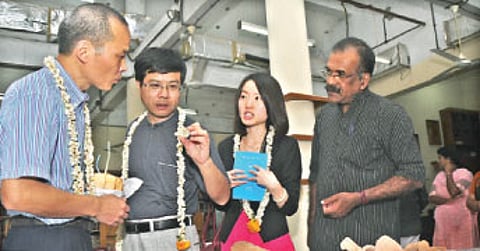

To explore possibilities in academic collaboration in archaeological and historical research, a six-member Chinese delegation led by Feng Nai’en, deputy director of the Palace Museum, Beijing, China arrived at the Kerala Council for Historical Research (KCHR) here on Tuesday.
‘’Palace Museum has a large collection of ancient objects and we have an ongoing project since the 1990s on the origin of ceramics. We have a massive compilation of ceramic sherds and we have been studying these with the help of modern technology. We are very interested in the Chinese ceramics excavated from Pattanam,’’ said Feng Nai’en.
This is not the first time that Chinese historians are attempting to study the Indo-China connection at Pattanam.
Archaeology student Ran Zhang, from Durham University in the UK, had earlier arrived in Kerala to study the Chinese ceramic sherds from Pattanam.
Among the current delegates, Wang Guangyao, ceramic expert and research fellow of the Palace Museum, has been identified as the potential scholar to study the Chinese ceramic assemblage from Pattanam.
The delegation had discussions with KCHR chairman K N Panikkar and KCHR director P J Cherian regarding mutual research interests and other possible avenues of collaboration. Cherian elaborated on the activities of the KCHR, projects related to Pattanam and educational opportunities for Chinese students at the KCHR.
A plethora of archaeological evidence of pre-8th century life at Pattanam was displayed at the KCHR for the perusal of the visiting delegation. One table was exclusively set apart for the blue and white ceramics of China, while others had Turquoise-glazed pottery, decorated pottery, rouletted ware, stones, beads, terracotta beads, glass fragments, neatly sliced stones, frankincense, copper wire, copper nail, stylus, iron knife and even gold artifacts.
The excavations at Pattanam had attracted global attention and had brought out important evidence on the vibrant maritime trade along the Mediterranean, Red Sea and Indian Ocean coast.
While the amphora and Roman glass are said to have a Mediterranean origin, torpedoes and frankincense pointed to a West Asian connection. The Chinese pottery were the traditional blue on white porcelain.
The team studied in detail each of the artifacts and discussed on how to go forward with the project. ‘’In China, the people who live close to such archaeological sites are made to involve in the project and there is quite a lot of public involvement in such projects,’’ said Feng Nai’en.
Apart from Feng Nai’en, who heads the delegation, the other members include Tian Yuxiao, director, human resources; Du Rongli, director, administrative services; Li Yongxing, deputy director of conservation and Wang Guangyao, research fellow, Department of Objects, the Palace Museum.
The Chinese delegation will be in the state for two days and are also scheduled to meet Education Minister P K Abdu Rabb and Higher Education Department Principal Secretary K M Abraham.