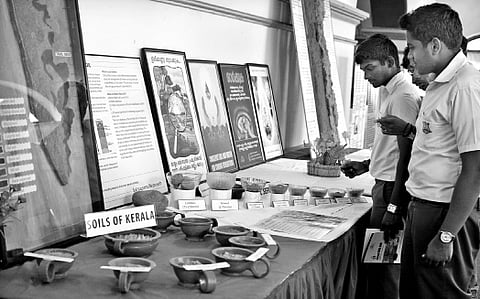

THIRUVANANTHAPURAM: In connection with the World Soil Day celebrations conducted by Soil Survey and Soil Conservation Department, a one-day exhibition was conducted at Kanakakkunnu Palace on Friday. The exhibition featured reports on soils found in panchayats across Kerala. The soil in the state varies from panchayat to panchayat, and plot to plot, according to Soil Survey and Soil Conservation Department officials.
Soil Survey and Soil Conservation Department assistant director Sudheesh Kumar said, “Kerala has the highest diversity of soil in the country. There are five factors which lead to the formation of soil. These are: climate; soil organisms; relief (the slant of the surface); parent material; time. In Kerala, we have heavy rainfall, which leads to erosion of minerals from the soil. Because of the high temperature, the soil organisms are always active. Then we have diverse rocks - the parent material.”
Kerala Soil Museum in Thiruvananthapuram has the largest collection of soils in the world. A soil museum in Netherlands technically holds the record of having the largest collection of soils - they have soils from various countries. The one in Thiruvananthapuram has more number of soils, but all are within the state, and therefore does not qualify for the record. Efforts are on to collect soils from other states.
At the museum, the soils are preserved as monoliths - huge blocks excavated from the earth. Two such monoliths - one from Kattur and another from Kottarakkara - were displayed at the exhibition. The Kattur monolith was brown in colour and looked more grainy. The Kottarakkara monolith was yellowish red.
Sudheesh Kumar said that the Kattur monolith was probably taken from near a river while the Kottarakkara monolith must have been on a hill. He said that preparing monoliths is a strenuous job. Here’s how they make it. They insert two flat wooden boards into a two-metre-deep pit, trap the sand in between, cover it on the third side and take the block out. Lacquer is applied between the board and the sand.
Though the exhibition is over, the monoliths can be viewed at the museum in Parottukonam. There are around 80 such monoliths, each with a different history of formation.
