
THIRUVANANTHAPURAM: Vamanapuram has always been a good example of India’s water paradox - flood during monsoon and severe drought during summer. However, this year things have changed for the better, even if only slightly, mostly because of a project launched under Integrated Watershed Management Programme (IWMP).
The first positive sign of change is that around 300 houses and 23 public institutions have set up rainwater harvesting systems at their homes, ever since the project started working in 2013-14. It may not be a dramatically high number as the project covers 13 panchayats spread over 7,492 hectares. But several more people, who can afford to pay 10 per cent of the Rs 9,000 assistance allotted for the rainwater harvesting system, are coming forward to be beneficiaries in the scheme.
The slight difference is visible this summer in the wells which have set up the water recharge system. “We are yet to study the difference the project has made to our water table. But the wells which would nearly dry up during summer have sufficient water this time,” says Sareena A Rahman, Block Development Officer.
Of the 13 grama panchayats, 10 are in Vamanapuram block, two in Nedumangad and one in Chirayinkeezhu. The project covers six watersheds connected to the Vamanapuram river - Aruvippuram, Cheruvalam, Kanchinada, Moozha, Ayanikuzhi and Nallanadu.
Though the Central Government had launched IWMP in 2009-10, activities towards implementing it started only in 2012. In order to spread awareness about the programme, several entry-level activities were conducted. A ‘water testing’ campaign was held with the help of Communication and Capacity Development Unit (CCDU). Several Plus-Two students were involved in the project to test water from open wells for contamination.
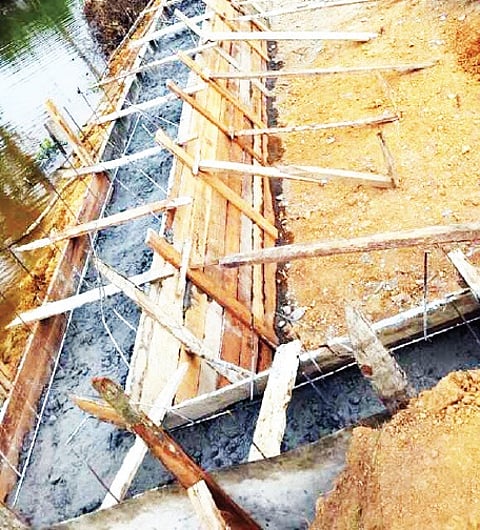
In order to arrest the flow of water, trees will be planted and contour bunds will be constructed on the top part of the ridges that form the boundary of the water table. Check dams and side walls will be constructed at the foot of the ridges. For every hectare, a budget of Rs 15,000 has been allotted. The total cost of the project is Rs 11.23 crore. Another project which focuses on three panchayats in Vamanapuram block panchayat is about to be started. The Rs 4.29-crore project covers 2,866 hectares.
Ponds and small water bodies were and are being revived. “Around Rs 11 lakh and Rs 14 lakh was spent on Parameswaram Chira and a pond inside a pre-matric hostel in Vamanapuram, respectively. An 8-lakh bund was built to retrieve a 15-acre farmland in Valiyakattakkal which was lying unused for years, after its bund was damaged,” says Jyothsna T M, Assistant Engineer at IWMP.
The IWMP work is not restricted to water bodies. Since soil health plays an important role in the quality of water, there have been initiatives to encourage organic cultivation.
For an amount of Rs 500, 25 grow bags were distributed to each household. Moreover, Joint Liability Groups were formed, consisting of Kudumbashree workers, and were given Rs 25,000 each as seed money to support the animal farm. This phase, known as Natural Resource Management, uses 56 per cent of the IWMP funds.
Starting with the mango showers in April, the recharge systems have started doing their job. Vamanapuram sounds hopeful about a drought-free, flood-free future.
