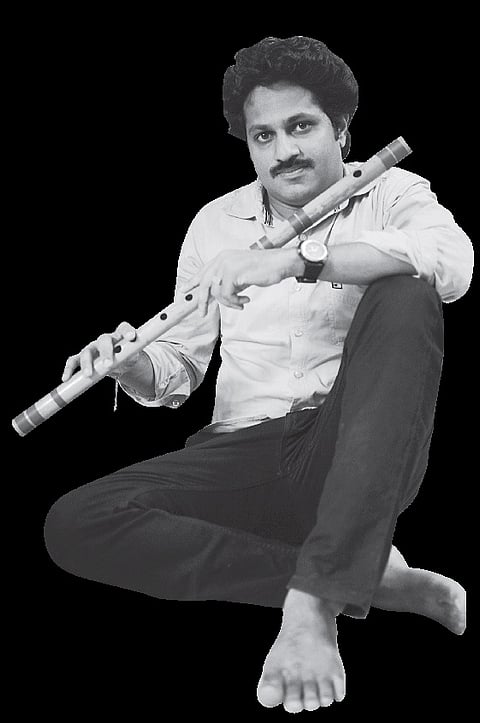

THIRUVANANTHAPURAM: He eats, drinks and breathes flute. Varun Kumar, a native of Nettayam, just adores the wind instrument so much so that he not only blows mellifluous sounds out of it but also hand crafts them from raw bamboo.
He was initiated into the world of flute at a tender age and by the time he was 17 he began to be known as a flautist under the guidance of Chalakudy N S Ganapathy.
Before long he realised that the flutes available was of poor quality and began to work on them and learnt the ropes of repairing them and later making quality ones.
"Flutes that I used to get were of poor quality and I had to repair them to get the clear notes. If flutes are not good it affects performance," says the 30-year old artist.
When he learned that many like him needed good quality flutes for performance, he started making them on a bigger scale. "Once we know how to play the flute well I think it is easy to make one. The only thing one needs to know is to adjust the 'sruthi' and the notes on the flute," he says.
Now Varun is a one-stop shop for flutes in the city. Most leading flautists get their flutes from him. Varun sells his flutes all over the county and even abroad. He makes flutes according to the demand. "On an average I make 10 flutes a day." he says. When the demand is high he seeks the help of his friend Anil.
To get quality bamboo he scouts for them in Kollam, Thenmala, Adimali, Nilambur and sometimes even goes to Assam. Bamboos collected are seasoned for a while and then cut to size and polished. Holes are made on polished bamboos according to the 'sruthi' (smallest interval of pitch that the human ear can detect).
But flutes cannot be made in large quantities for storing. Bamboo expands or contracts according to the climate and affects the quality of the sound produced by it. To tide over this various materials are used for making flutes for different climatic conditions, he says. Yet bamboo is the preferred material because it consists of inter nodes. These nodes help in deciding the length of flutes.
Flutes are categorised into two - Carnatic and Hindustani, according to its length and breadth. "Most of my flutes are the Hindustani kind. Hindustani flutes can be used for light music also," says Varun.
He makes a flute set comprising 24 flutes, of different tones and sruthis. Flute making is just a hobby for him. He also collects various wind instruments from different parts of the world. Didgeridoo from Australia, tin whistle or penny whistle from USA, ocarina from Italy, Dizi flute from China, Japanese shakuhachi, and different types of Indian wind instrument such as makudi, shangu and Nadaswaram are part of his collection. But deep down in his heart he is passionate about playing the flute. He says he likes to be known as a flautist than a flute maker. Varun performs for television and stage programmes whenever possible.