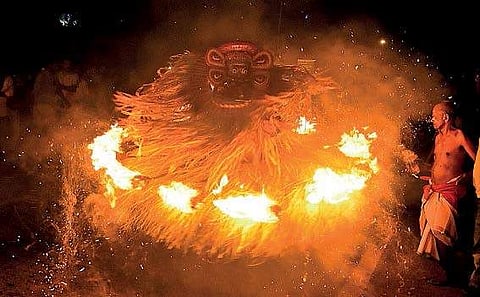

THIRUVANANTHAPURAM: It was an eerie sight to watch Nagakali, the fierce goddess with drooping serpentine eyes, walk down a city street. She stood in the neon florescence, far from the dim-lit sacred groves she usually roams. Stepping into the open theatre at Manveeyam Veedhi, she danced and roared in front of a mystified crowd, most of them having their first tryst with the walking gods. They were witnessing a recreation of Perumkaliyattam, the spectacular ritual dance usually conducted at an interval of 12 years or more.
“We perform theyyam after a spate of rites and rituals as it’s related to temples. Normally there will be one theyyam, the presiding deity of the shrine. A volley of theyyams come together for Perumkaliyattam which is very rare,” says Narayanan Peruvannan, the veteran theyyam artist who was in the city for National Folk Festival.

Eight magnificent theyyams marched to the venue, their heavy anklets making a wild, jingling sound. The bright crimson flames from the nearby pyre flushed their painted faces, adding to the drama.
Ghandakarnan arrived with burning torches attached around his waist, his long mudi set aflame at places. As the drum beats reached a frenzied rhythm, he screamed in fury and walked into the heap of burning logs. He kicked at the glowing red cinders, splashing them all around. Then, he started fast rotations creating a shimmering circle of fire all around. Spectators were breathless, some of them folding their hands in fear and reverence.
Each deity has a legend, says Prajish, the son of Narayanan Peruvannan who played the mighty Ghandakarnan. “The angry Ghandakarnan jumped out of Shiva’s neck to destroy enemies while the lord was meditating,” explains Peruvannan. He adds Nagakali is a fertility goddess worshiped by childless parents, and “at temples they also conduct pulluvan pattu to appease the deity.”
Gulikan, another inevitable part of kaliyattam, enters with a unique, long headgear. Panchuruli, Kutti Sasthappan, Karnavar and Karinkali were the other theyyams who performed.
Narayanan Peruvannan says there are hundreds of theyyams, each with their signature costume and choreography. “Making costumes with tender coconut leaves, mukhathezhuthu, music - all these are passed down from generation to generation. We don’t have any schools teaching theyyam since it has an element of divinity. In our clan we do it with utmost respect and reverence,” he adds.