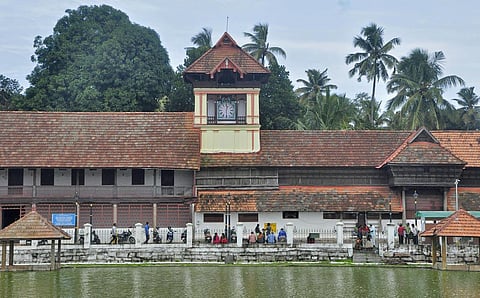

THIRUVANANTHAPURAM: Methan mani, the grand old clock near Padmanabhaswamy temple, is a forgotten piece of engineering marvel. It stands tall facing the Padmatheerthakulam. Methan mani was constructed before the Big Ben clock tower in London. Though the first clock tower of Travancore was set up near the Padmanabhapuram Palace, Methan mani elicited more fame.
Officially, the clock tower was known as Mani Soothram. Being placed above the Manimalika, too, contributed to its name. “The clock was constructed in 1751 by Arulananthan Meyyappan. Later, Karthikathirunal Rama Varma, also known as Dharma Raja, ordered an addition of the face of a middle-aged Muslim with two goats locking horns,” says historian M G Sasi Bhushan.

“In 1766, the clock was reportedly repaired in Cochin. The clock works on an older calculation of ‘nazhika’ and ‘vinazhika’. The meeting of Dutch East Indies former governor-general Gustaaf Willem Baron van Imhoff with Marthanda Varma at Thengapattanam may have resulted in the need for setting up a clock tower.”
It was the priests, who came to Thiruvananthapuram for Murajapam, who ensured that the glory of Methan mani goes beyond Travancore. “In my opinion, Methan mani is a symbol of propaganda war,” he says.
“The royal family had appointed personnel to strike the bell each hour.
Some say that the clock was called ‘Mesham Mani’ since there is a goat in it. But historical documents don’t support this argument,” says Uma Maheshwari, author of Mathilakam Rekhakal. Leela Bai, 75-year-old resident of the city, says, “We were amused to see the face placed at the centre of the clock opening its mouth after every hour. As a kid, I watched the clock’s mechanism a lot,” she says.