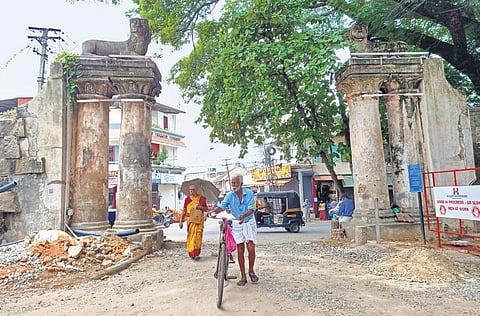

THIRUVANANTHAPURAM: It is a matter of shame that the centuries-old iconic Fort Wall, a heritage monument located in the heart of the capital city, continues to be in a state of ruin. Parts of the 4.5km structure and the gateways are dilapidated, thanks to years of neglect.
Though the state archaeology department recently initiated efforts to conserve the wall, widespread encroachment has impeded protection measures. Notably, according to sources, no major conservation activities were undertaken in the past two decades.
Declared a protected monument by the Archaeological Survey of India (ASI), the state government is bound to protect the monument under the Ancient Monuments and Archaeology Sites and Remains Act of 1968. However, the apathy is glaring.
“The Fort Wall is in a state of deterioration, and it’s disheartening to see the condition of the structure in many places,” says Fort ward councillor Janaki Ammal S.
“I have taken this up with the government and archaeology authorities many times, and given memorandums urging the intervention of the authorities. This is part of our heritage. We need to protect it for generations to come.”
Janaki points out that the outer layer of the wall has worn off in some segments. “People burn waste piled near the wall. Also, wastewater and oil from the KSRTC garage have damaged the parts of the wall adjacent to it. A portion of the West Fort entrance is on the verge of collapse,” she laments.

Rampant encroachment
The inaction of the district administration and the city corporation has led to rampant encroachments and unauthorised construction around the Fort Wall area.Following an outrage, the state government had declared a 3-metre no-construction zone on either side of the Fort Wall in February 2022.
As per a survey carried out in 2019, there were about 250 encroachments around the Fort Wall area. Officials acknowledge that the encroachments have only increased since then.Growing illegal construction activities have finally prompted the archaeology department to deploy monument attendants to keep a watch.
“Most of the encroachers undertake construction at night during weekends and public holidays,” notes an archaeology department official. “We have assigned our attendants to monitor such activities and report to the authorities. The district collector has issued an order mandating a no-objection certificate from the archaeology department for power and water connections to such illegal structures. But those already having a home or shop undertake construction discreetly. It is challenging to undertake conservation activities because of these encroachments.”
It is apparent that conservation will be impossible without political intervention.“There are hundreds of street vendors, and the civic authorities are unable to do much because it’s a matter of their livelihood,” says the official. “The archaeology department doesn’t have any power to take action.”
To include the Fort Wall in its asset register, the archaeology department has requested the revenue department to survey the heritage structure and officially hand it over. “If done, we can ensure its upkeep. We have taken it up with the state government. All encroachments need to be cleared,” the official says.
Small startDespite the challenges, the archaeology department has launched conservation activities along a 380m stretch of the wall from the West Fort area to the ‘Simhakotta’.
“It’s a one-year-long project, and the work has been awarded,” the official confirms. “There is not much encroachment on this stretch. The project will cost about Rs 60 lakh. No well-planned conservation efforts were undertaken on the structures in the past decades. For the past five years, we have been studying and planning this.”
Conservation will be done in a traditional manner. “The initial plastering was done using lime, and original materials will be used to conserve the wall,” the official explains. “It was a challenge to find competitive contractors for this work. The process of conservation requires specialised workmanship.”
The department is planning to conserve the ‘Vettimuricha Kotta’ as well soon. “The project cost is about Rs 25 lakh. We have received administrative sanction, and will soon award the work. We hope to complete it in nine months,” says the official. “It’s not possible to undertake the conservation of the entire wall as a single project.”
‘State govt should intervene’
“It is unfortunate that the protection of heritage structures is not being prioritised. Preventive maintenance is essential for the conservation of heritage structures. Fort Wall is exposed to sun and rain, and there is growth of vegetation on the structure. The Art and Heritage Commission has done the framework for a legislative draft for the protection of heritage structures. The government has to approve it. It’s high time the state intervened and set up a dedicated mechanism to monitor the protection of heritage structures. The archaeology department has its limitations. The scarcity of funds is a major challenge.”
— Eugene Pandala, member, Art and Heritage Commission