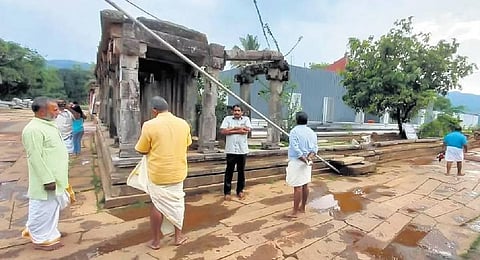

THIRUVANANTHAPURAM: The High Court-appointed advocate commissioner has recommended legal action against the officials responsible for the controversial renovation of the Thirunelly Maha Vishnu Temple in Wayanad. The court is currently hearing a petition that alleges the demolition of the centuries-old iconic temple without considering the possibility of restoration.
The report submitted by advocate commissioner M R Arun Karanavar suggests legal action should be taken against officials involved in demolishing the temple’s age-old structures. It also suggests an audit of the funds collected for the current construction and previous works, including those related to the sanctum sanctorum.
It has been found that the donations for the renovation were illegally deposited in the account of the renovation committee, and they should be transferred to the account of the Malabar Devaswom Board.
The report also calls for seizure of records related to devaprashnam (divine consultation) and tendering of works. The renovation committee, which claims that the reconstruction was based on the findings of devaprashnam, failed to provide the necessary records to the commissioner.
The report emphasises that the reconstruction of Chuttambalam and Balikkalpura, as well as the restoration of vilakkumadam, should be carried out with clearance from the environment and archaeological departments.
Any dismantled materials of antique and archaeological importance should be preserved or utilised in the reconstruction. The report says that considering the temple’s location atop a hill, it is crucial to ensure environment-friendly construction practices to avoid potential natural disasters.
The demolished chuttambalam did not have an underground basement, likely due to geological considerations. However, the new construction features a cement basement, and its environmental risks should be thoroughly studied by an expert committee.
Future works at the temple should be supervised either by the HC or the district judge of Wayanad.
The report also highlights that the new toilet complex was constructed in the traditional location where believers used to immerse the deceased's ashes.
This building poses a risk of contaminating the Papanasini stream and the Panchatheertham pond, and it is recommended to remove it. The report says all new construction and renovation works at the temple should receive approval from the archaeology and environment departments.
