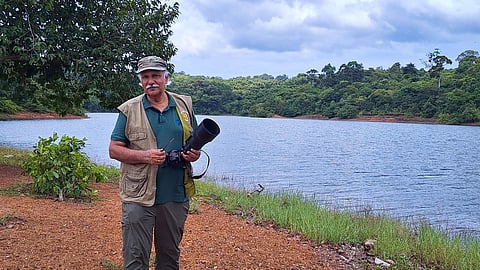

A verdant path leads to Murali Sivaramakrishnan’s house at Jawahar Nagar in Thiruvananthapuram. The narrow way opens into an expansive hall, where books, paintings, ideas and reflections on literature, philosophy and art together create a soothing space.
In the courtyard, there is an echo of birdsong; the richness of the garden suggests they, too, have found a home here. The canopy offers comfort, shielding one from the scorching mid-day March sun. Their chirps grow louder on days when Murali and his wife Usha are away, almost warning off anyone who comes knocking.

The day I visited, Murali, a man of many talents, was preparing 80 photographs for his first solo exhibition, now on at the Museum auditorium.
“They were clicked in different time periods. When I first grew interested in birding as an English literature student in college, I used to sketch birds. Later, the camera took over,” he says.
Murali recalls his student days in Thiruvananthapuram, when he moved with enthusiasts of the Kerala Natural History Society (KNHS). There were trips into the woods and tete-a-tetes with veterans like Salim Ali, who visited the young birders. “I was in my own world, as nature filled me with words and a love for birds,” he says.
Life took him to Pondicherry as a faculty member at Pondicherry University, a forested campus set within the reclusive ambience of the coastal town. “The campus was then more like a forest, with thick foliage and trees. There were enough birds for me to indulge in birding. I found my passion growing into a mainstay of my life,” he says.
The Pondicherry phase also shaped his understanding of the delicate balance humans must strike with nature.
“The ecology was often disrupted by ‘development’; trees were cut down, habitats destroyed. We staged protests, wrote umpteen letters, urging that development move in tandem with nature. Our efforts helped save the habitat of the yellow-wattled lapwing, which still thrives on the campus. We formed teams working towards ecological health and even created courses like The Green Voices, merging literature and ecology. It remains a popular elective,” says the academic, who has since retired and settled in Thiruvananthapuram, devoting more time to birdwatching and writing.
He has several books to his credit, spanning environment, literature and philosophy. “All three are deeply connected. That’s what my inner journeys have shown me,” he says, with a copy of Sri Aurobindo: Aesthetics and Poetics by his side.
Back in Thiruvananthapuram, he has observed unsettling changes in the city’s ecological fabric. “Leave aside the rampant cutting of trees in public spaces, people now do not want to tolerate even fruit trees branching into their homes. They want vegetation cleared, even if it offers shade and peace. A very strange change indeed,” he says.
He notes that the blue jay, once a common sight in the Kanakakunnu Palace grounds during his student days, is no longer seen. “That, to me, is a real loss,” he adds.
Murali’s exhibition, on till April 3, offers a glimpse into a mind where birding, poetry, and philosophy converge.
“Literature, poetry and philosophy are not different from ecology. The text of one runs into the texture of the other. Even those deeply rooted in science understand how scientific thought merges with the essence of literature and philosophy. One complements the other,” he says.
He points to his book Notebook of a Naturalist, a collection of bird poems illustrated with his own sketches.
“I used to paint birds before switching to the camera. Now, there are endless technical possibilities with photography. That has its positives, as we see in the work of the young and the tech-savvy. Yet beyond all that, what shines is the sense of home one feels in nature, and the satisfaction of standing up for it, our true haven,” he says.
His latest book, 50 Years of Chipko, he describes as deeply emotional.
“Yes, emotional. Not technical or literary, but emotional. That is what birding and nature mean to me,” he smiles, bidding goodbye.