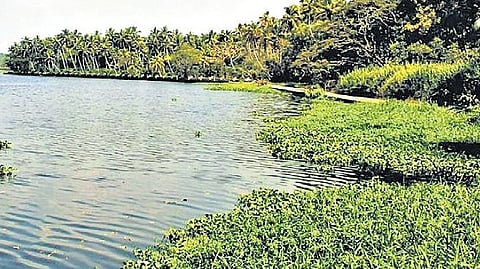

THIRUVANANTHAPURAM: Three decades of rapid urbanisation has reduced Akkulam Lake’s open water spread by nearly half and wiped out over 80% of the surrounding wetland system, significantly weakening one of Thiruvananthapuram’s most important natural flood buffers, a new peer-reviewed study has found.
Published in the journal Discover Cities, the study warns that the continued degradation of the Akkulam-Veli wetland system has substantially increased the city’s vulnerability to urban flooding, with the October 2023 inundation serving as an early warning of what could become more frequent under a changing climate.
The study, by spouses Sarun S of the Centre for Disaster Studies, Sree Sankaracharya University of Sanskrit, and Vineetha P of Kerala University’s Inter-University Centre for Geo-spatial Information Science and Technology (IUCGIST), analysed satellite imagery and geospatial data from 1995 to 2023.
It found that Akkulam Lake’s open water area shrank from 2.73 sqkm in 1995 to 1.46 sqkm in 2023, while the overall Akkulam-Veli wetland system declined by 81%, from 12.78 sqkm to just 2.38 sqkm.
According to the researchers, the wetland is the backbone of the capital’s natural drainage network, receiving runoff from streams including Kannammoola, Kulathoor, Amayizhanjan and Sreekaryam. Besides storing excess stormwater during heavy rains, it recharges groundwater, regulates the local microclimate and supports biodiversity.
“The wetland is not just the waterbody that people see. It includes the surrounding marshlands, streams and connected landscape that together perform critical ecological functions. Once this network is fragmented, the city gradually loses its natural defence against floods,” said Sarun.
The researchers attribute the degradation to sustained urban-expansion projects across the wetland’s catchment, including NH 66 bypass widening, Technopark expansion, and other large commercial and residential developments along the Kazhakkoottam-bypass corridor.
“Every city should be planned around its most significant geographical feature if development is to remain sustainable. In Thiruvananthapuram, however, almost every major infrastructure project has come up within the Akkulam wetland catchment, fragmenting the ecosystem instead of conserving it,” Sarun said.
The researchers found that average hill elevations in the catchment have dropped from around 60 metres in 2001 to nearly 52 metres in 2023, allowing rainwater to flow much faster into low-lying areas.
Sarun cautioned against viewing the 2023 floods as a one-off. “Extreme rainfall events are becoming more frequent. The only sustainable way to reduce urban flooding is through nature-based solutions, and wetlands are central to that. Many developed countries are creating artificial wetlands under the sponge-city concept. Thiruvananthapuram already has a natural system, but we are steadily degrading it,” he said.
Vineetha said a sharp ecological decline within the wetland has reduced the lake’s water spread. “I am a Thiruvananthapuram native who passes by the lake almost every day. The biodiversity has declined and migratory birds that once frequented the Akkulam-Veli wetland have largely disappeared. We need to protect whatever is left,” she said.
Recommendations
The study recommends restoring degraded marshes, protecting laterite hillocks, reconnecting natural drainage channels and incorporating nature-based planning measures into future urban development.
