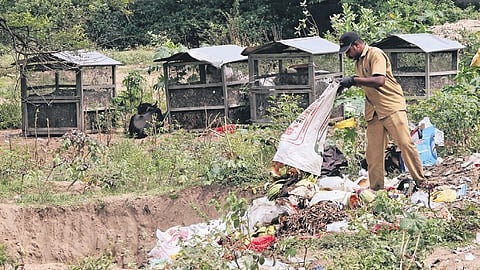

THIRUVANANTHAPURAM: Despite tall claims of door-to-door waste collection, segregation and scientific disposal, Beemapally is turning into the city’s dump. In view of the ongoing Beemapally Uroos festival, corporation workers were seen burying plastic and heaps of mixed waste in an open plot in close proximity to the mosque. The mounting problem is turning into a major environmental crisis for a locality with a population of more than 60,000.
Beemapally councillor E Sajeena Beevi alleged that plastic and mixed waste are being dumped at multiple locations in the ward. She said that 21 additional workers have been deployed to clean up the dump sites, bury biodegradable waste and collect non-biodegradable materials. However, the large volume of garbage and the absence of an effective disposal mechanism have made the task difficult. She said waste was being brought from areas such as Puthenpally and Ambalathara, as well as other wards located five to seven kilometres away.
“People dump waste transported from other wards. We have repeatedly demanded that the corporation deploy enforcement squads to prevent this, but no effective action has been taken,” she said, adding that there are three hotspots and every empty parcel of land is being used for dumping waste.
Despite repeated demands, the civic body has not deployed enforcement squads at vulnerable spots, she alleged. “Even two people stationed in the area around the Matsyafed Nylon Net Factory would make a difference. I have been raising this demand for a long time, but the corporation has not acted,” Sajeena said.
In a ward where nearly 80% of the population depends on fishing, with many families relying on irregular daily earnings, the mounting waste crisis has exposed the failure of the corporation’s collection, transportation and enforcement mechanisms, leaving residents to bear the consequences.
The councillor said residents are required to pay `300 a month for food-waste collection and another `100 for plastic collection, making the service unaffordable for many households. The lack of decentralised processing facilities has further aggravated the situation. A site had reportedly been identified in the ward for setting up a biogas plant to process biodegradable waste, but the project has not materialised even after a year, Sajeena said.
S M Vijayanand, special rapporteur-cum-special monitor appointed by the Kerala State Human Rights Commission (KSHRC) to assess solid waste management in Thiruvananthapuram corporation, said community participation is central to resolving the coastal waste crisis.
“Local churches and jamaats hold significant influence. By framing environmental sanitation and proper waste management as matters of community pride and self-respect, we can drive meaningful behavioural change on the ground,” he said.
Vijayanand said, “The reluctance among local residents to engage with Haritha Karma Sena isn’t entirely over user fee. A primary concern raised by the community is the lack of regularity in waste collection services,” he said.
