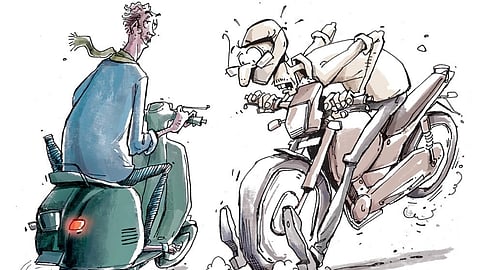

VIJAYAWADA: Wrong-side driving has become so common in Vijayawada that many motorists no longer hesitate to flout the rule. From two-wheelers and cars to auto-rickshaws, commuters are routinely seen travelling against the flow of traffic despite challans and enforcement drives.
Motorists often take the wrong side to avoid U-turns or save time, but officials warn the practice is among the city’s most frequent violations and greatly increases the risk of head-on collisions, especially involving two-wheelers and pedestrians. It also disrupts traffic flow, forcing those driving correctly to brake or swerve suddenly.
For residents, such incidents have become routine. Speaking to TNIE, Nagu of One Town recalled: “Once an auto was coming in the wrong direction from the Canal Road flyover and we had a little crash. In return, he blamed me for not driving correctly.”
Governorpet Traffic Sub-Inspector Baig said violations persist despite regular enforcement. “In my jurisdiction alone, we issue around 10 challans daily for wrong-way driving. But this problem exists across the city,” he said. He added that motorists often obey rules only when police are visible.
“Even after barricades and challans, several continue to violate traffic rules.”
Baig stressed that enforcement alone cannot solve the issue. “The public needs to understand that wrong-side driving is dangerous not only for themselves but also for others. Civic responsibility has to come into play,” he said.
Officials believe lasting solutions lie in changing public attitudes. With traffic volumes rising, they say road safety depends as much on civic responsibility as on policing. Until motorists treat rules as safeguards rather than inconveniences, wrong-side driving will remain an everyday hazard.
Khushali Agarwal
