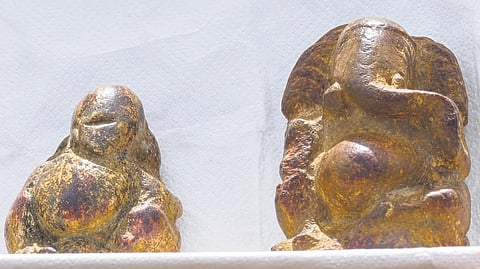

VIJAYAWADA: Two rare 1,600-year-old Ganesa idols carved in red sandstone were discovered in Kaja village of Guntur district, shedding new light on early Hindu iconography in the region.
According to E Sivanagireddy, archaeologist and CEO of Pleach India Foundation, the idols were found while local agriculturist Simhadri Venkatarama Reddy was ploughing his field. Responding to the information, Reddy examined it.
The two miniature idols measure 5.0 × 3.0 cm and 4.0 × 2.0 cm. Both depict Ganesa with two arms, holding a modaka in the left hand and a danta, or broken tusk, in the right. They feature natural elephantine heads without headgear, and are seated in lalitasana. Sivanagireddy identified it as typical of the Anandagotrin period of the 4th century CE.
He noted that the idols closely resemble a limestone Ganesa image from Chejarla, the capital of the Anandagotrins. The discovery yielded potsherds of red, black, and tan ware from the Satavahana, Ikshvaku, and Anandagotrin periods, indicating continuous settlement.
Sivanagireddy stated that the Anandagotrins succeeded the Ikshvakus and later shifted their capital from Chejarla to Kanthene. He has appealed to the landowner to preserve the idols for posterity.
