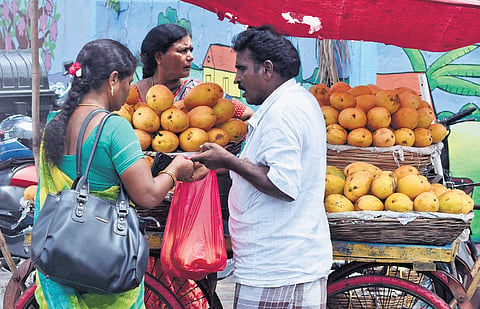

VIJAYAWADA: Plastic carry bags thinner than the permitted 120-micron limit continue to be used widely in Vijayawada’s busiest commercial markets despite regular inspections, awareness campaigns and penalties imposed by the Vijayawada Municipal Corporation (VMC), highlighting weak enforcement of the ban on single-use plastic (SUP).
The continued violations come even as the Centre informed the Lok Sabha during the ongoing Monsoon Session that authorities have conducted more than 8.62 lakh inspections nationwide since July 2022, seizing 1,990 tonnes of banned plastic and collecting Rs 19.85 crore in fines to enforce the SUP ban.
In Vijayawada, authorities collected Rs 44.81 lakh in fines and seized 8.64 tonnes of banned plastic between January 2025 and June 2026. During 2025 alone, Rs 33.76 lakh was collected as penalties and 5.61 tonnes of plastic were seized. In the first six months of 2026, officials collected another Rs 11.04 lakh in fines and confiscated 3.02 tonnes of banned plastic.
Speaking to TNIE, VMC Chief Medical Officer of Health (CMOH) (Incharge) Gopal Naik said, “On an average, sanitary inspectors collect around Rs 2,000 to Rs 3,000 in fines every day during inspections. Most violations involve plastic carry bags below the prescribed 120-micron thickness. A majority of these cases are reported from Kaleswara Rao Market and Rythu Bazaars,” he told TNIE.
Besides enforcement, the civic body has been conducting awareness programmes among traders, vendors, schoolchildren and the general public to encourage the use of eco-friendly alternatives. As part of one such initiative, around 50 jute bags were distributed every day for five days at Patamata Rythu Bazaar. The VMC has also been creating awareness through social media campaigns, including Instagram reels.
The AP Pollution Control Board (APPCB) has also been organising Kalajatha programmes across municipal corporations and municipalities in Krishna and NTR districts. APPCB Environmental Engineer P Srinivas Rao said, “Wall posters have been displayed at gram panchayat offices and other prominent public places to spread awareness on the ban. He added that the Board is continuously monitoring plastic carry bag manufacturing units to ensure they do not manufacture bags below the prescribed 120-micron thickness.”
Naik said seized plastic is transported to the garbage transfer station at Ajit Singh Nagar before being sent to the Jindal waste-to-energy plant for processing.
Highlighting the environmental and health concerns associated with indiscriminate plastic use, he said banned plastic is non-biodegradable, clogs drains and is often consumed by stray animals. He also cautioned against using plastic for serving hot food, saying it could pose health risks.
Under the Plastic Waste Management (Amendment) Rules, identified single-use plastic items have been prohibited since July 1, 2022, while the manufacture, stocking, distribution, sale and use of plastic carry bags below 120 microns have been banned since December 31, 2022.
