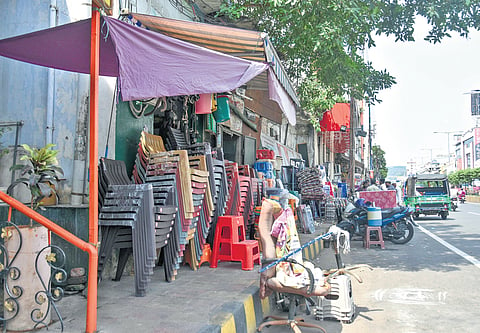

VIJAYAWADA: Even as the Supreme Court has declared unobstructed footpaths a fundamental right under Article 21, Vijayawada Municipal Corporation (VMC) officials have said correcting the city’s existing footpaths is not possible, citing limitations in road width and existing infrastructure.
The Supreme Court, in its June 19 verdict, held that states and civic bodies have an “enforceable duty” to provide continuous, unobstructed footpaths and that the right to walk on demarcated footpaths “shall have priority over movement by motorised vehicles”.
The ruling came in a motor accident compensation case involving the death of a five-year-old child who was hit by a tanker while walking to school because there was no footpath or pedestrian crossing at site.
While deciding the case, the Bench of Justices PS Narasimha and AS Chandurkar held that the right to walk on demarcated footpaths “shall have priority over movement by motorised vehicles”.
Despite the court’s observations, footpaths across Vijayawada remain encroached upon and unsafe for pedestrians. Signboards jut into walkways at head height, often covered with layers of political posters. Electric poles occupy pavements, with low-hanging wires obstructing movement. Construction materials, including gravel, sand and bricks, block stretches of footpath, forcing pedestrians onto roads.Two-wheelers are routinely parked on pavements, while shops extend steps, displays and sheds into pedestrian spaces.
In areas such as Tunnel Road, Kanaka Durga and Bhavanipuram, footpaths also serve as night shelters, leaving little room for pedestrians.Most pavements lack ramps for wheelchair users, while tactile pathways for the visually impaired are absent.
“It is very difficult to walk on this footpath as bikes are mostly parked here and mostly shops have their steps outside,” said Satyya, a pedestrian in MG Road who spoke to TNIE.
“Look around if you can see space for us to walk on footpaths,” said Raja,a resident of Governorpet.

The lack of usable footpaths also contributes to traffic congestion. “In main junctions it becomes difficult as there is no footpath so people stand on roads and talk to us. So traffic happens and traffic police also sometimes tells us to move,” said Harish, a service auto driver.
Julie, a resident of Patamata, said pedestrian safety remains a concern for children. “Yes, footpaths are an issue. For me my kids get dropped inside the street so it’s fine, but what about kids who are dropped on main roads?” she asked.
Speaking to TNIE, VMC Superintendent Engineer Chandrashekhar acknowledged the city’s shortcomings and said only a few roads have adequate space for footpaths.
“Vijayawada doesn’t have many wide roads except some like Bandar Road, Eluru Road and BRTS roads where footpaths are there. Town Planning is taking care of the encroachments and repair works are taken care of by the engineering department,” he said.
More significantly, the official ruled out the possibility of rectifying many of the city’s existing footpaths. “These footpaths are previously constructed and making any corrections to them will not be possible. Hence any future constructions will fully be according to the norms of the Supreme Court,” Chandrashekhar said.
He added that no new footpaths have been sanctioned at present. “At present though no new footpaths are sanctioned as there are no wide roads. A comprehensive team will be formed, surveys will be taken to meet this problem,” he said.
National standards require a minimum clear walking width of 1.8 metres, along with ramps and tactile paving. However, many of Vijayawada’s footpaths fail to meet these norms because of parked vehicles, shop extensions, gravel, tilted poles, low-hanging wires, political posters, and night settlers, with no ramps or tactile paths.
The Supreme Court observed that urban planning in India had long prioritised vehicles over pedestrians.
“Wheels eclipsed our imagination, and our municipal administration was busy creating roads that are suitable for motorised vehicles,” the court noted.
While the apex court has recognised safe and unobstructed footpaths as an enforceable right, VMC’s admission that existing footpaths cannot be corrected raises questions about how and when pedestrians in Vijayawada will be able to exercise that right.
Khushali Agarwal