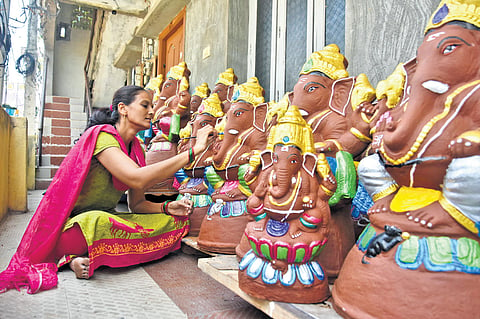

VIJAYAWADA: On Vijayawada’s roads, Ganesha has already begun to arrive, in towering idols waiting for pandals, in rows of brightly painted faces at roadside stalls and in the smaller clay figures devotees carry home. But behind the colour and celebration is a choice that will eventually follow every idol into the water: Plaster of Paris (PoP) or clay?
As Ganesh Chaturthi draws closer, idol sellers across the city are stocking up. With PoP idols continuing to dominate because of their smooth finish, vivid colours and elaborate detailing. Eco-friendly clay idols are available too, but sellers say they often have to convince buyers to look beyond appearance.
For 70-year-old potter Raghaviyah, who has spent nearly two decades making Ganesha idols, there is little doubt about what belongs in the water. His idols are made from natural clay sourced near the Polavaram canal area, along with coconut fibre and slaked lime.
Unlike PoP, he says, clay is a material with a traditional place in idol-making and far less environmental baggage after immersion. His son Shankar, said “Eco-friendly models are just around `10 more costly. But because PoP is everywhere, people don’t think about how they are harming society.”
That little difference in price, however, can hide higher cost after the celebrations. While a PoP idol may be cheaper at the time of purchase, its environmental cost does not end with visarjan. Unlike natural clay, PoP does not break down in water, leaving behind solid waste that can accumulate around immersion sites. The paints and synthetic colours used on many idols can add pollutants to the water.

“If people look around, they will find enough eco-friendly idol makers like us, even today. The issue is awareness,” Shankar said. The distinction is important, according to Andhra Pradesh Pollution Control Board (APPCB) Chairman P Krishnaiah. A clay coating, he cautioned, does not turn a PoP idol into an eco-friendly one.
“An idol cannot be considered eco-friendly merely because it has a clay coating. Eco-friendly idols should preferably be made entirely from natural clay and should be free from PoP and toxic chemical colours,” he said.
The Central Pollution Control Board has flagged heavy metals including lead, mercury, cadmium and arsenic in certain idol colours as environmental concerns. For Vijayawada, where the festival will once again bring thousands of idols to immersion points, the choice made at the time of purchase could have consequences long after the drums fall silent.
This Ganesha season, perhaps the choice is not only about how an idol looks before celebrations, but also about what it leaves behind once they are over. Looking beyond colour and gloss could mean choosing an idol that returns to earth with far less left behind.