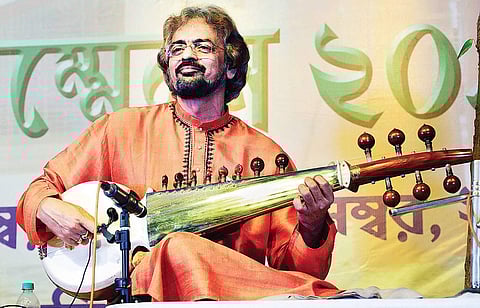

Music taught him to read the notes of his soul. Lyrical language seeped through his heart, caressing each nerve with a sonorous appeal that never left his side. Music has taught sarod player, Pandit Debojyoti Bose, the art of living. It’s not just a sensory discipline for him, but a spiritual undertaking for an accomplished life.
Performing on December 23 in the city, Bose is a fourth generation musician. His lineage can be traced to his great-grandfather Sri Akshay Kumar Bose, a zamindar of Pankobil in Jessore, now in Bangladesh, who was reputed for his tabla prowess. Later, his father Pandit Biswanath Bose took on the mantle as a tabla player of Benaras Gharana.
But Debojyoti didn’t pick up tabla, rather he gravitated towards sitar, an instrument that his mother played. He initially began learning the instrument from his mother but later took lessons from Ustad Amjad Ali Khan. “Knowing the man and his music became the reason for my life. He made me realise the value of life, and taught me that music was a medium to enrich it,” says Bose. His besottedness for his guru can be seen in how he has dedicated his upcoming show to him — he is performing compositions by Amjad Ali Khan. “I think the stylisation of any gharana is most evident in their compositions or bandishes. I adore how Khan Sahab has so beautifully increased the boundaries through his point of view, so I would like to explore them further,” he says.
From a naughty child who was difficult to control, to an instrumentalist who has become a principal promoter of Hindustani classical music in the 21st century, Bose sure has travelled a long way.
When the music started as a patronised art from, it didn’t have a direct social connection with the public. It was individualistic and feudal, Bose says. However, post-independence, when patronisation decreased, it transpired into an industry that treated music as a business. Dilution became prevalent. Knowing that well, Bose’s sustained effort has been to fight against it. He hopes people will protect their shared heritage. “After all, music is a mirror to society,” he says.
A non-classical song that you hum often?
Lag ja gale
A phrase that you repeat?
Crisis is the source of creativity
In times of need, who do you go to?
My brother Pandit Kumar Bose
A thing people don’t appreciative enough with regards to Indian performing arts?
Sense of proportion
A song you’d like to dedicate to you guru?
Guru ke bina koi gyan nehi pawe. It’s a song I composed.
