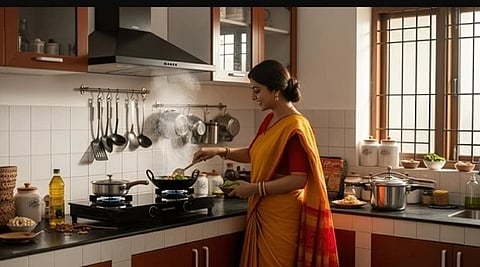

“Didi, humne toh thanda khaana khaana shuru kar diya hai.”
Seema Sah said this to me almost apologetically, as though she needed to justify a choice that was never really a choice to begin with. At twenty eight, she works across homes in Noida, holding together a family of five on a monthly income of about ₹30,000. The rising cost of an LPG cylinder has quietly, but decisively, altered the rhythm of her household. Breakfast is no longer cooked fresh. Meals are prepared just once a day, always in a pressure cooker, always with an eye on how quickly the flame can be turned off.
A cylinder that once cost around ₹910 now comes closer to ₹950 for those registered. For others, forced into the informal market, the price climbs to an unforgiving ₹2,500 to ₹3,500. One cylinder lasts her family barely two weeks. Every meal now carries the weight of calculation.
These shifts do not exist in isolation. They ripple outward.
At the subzi mandi in Sector 76, Hari Lal, thirty, stands beside crates of mangoes that are beginning to soften faster than they sell in the summer heat. The season, which should have brought brisk business, is instead accelerating his losses. He tells me he earns between ₹1,000 and ₹1,200 on a good day, though those days are becoming rare. “Fruit has become a luxury,” he says, not with drama, but with a kind of tired acceptance. What was once an everyday purchase has slipped quietly out of reach for many households. By evening, what remains unsold often cannot be salvaged.
He speaks, too, of the restaurants nearby. Many have reduced operations or shut altogether. The reason, he insists, circles back to the same source. High LPG prices. With kitchens going cold, orders to the mandi have thinned. The chain reaction is stark. “Gas ke daam ne poora mandi system hila diya hai. Logon ka kaam hi ruk gaya hai.”
Back in Sah’s home, the adjustments have grown more desperate. She tells me they have begun relying on lakkad and upale for daily cooking. Even these, once the cheapest alternatives, are no longer affordable. An upala that cost ₹1 now costs ₹5. For now, they gather wood by cutting branches near their home, but she knows this is temporary. Soon, even that will come at a price they cannot bear.
There is also a quiet, growing fear of another lockdown. The memory of it lingers. Survival, for many, still feels fragile.
Even the smallest safety nets are fraying. The modest eateries that once served a plate of food for ₹20 have doubled their prices to ₹40. For daily wage workers, that difference is not trivial. It is the difference between eating and going without.
Vendors speak with a mix of frustration and resignation. They question why no action is taken against the illegal sale of LPG cylinders, even as they are forced to depend on it. Gas agencies, they say, are often shut, or claim to have no supply. Access itself has become uncertain.
Sah recounts an experience that has stayed with her. Though her family now lives in Noida, her grandmother’s gas connection is registered in Ashok Nagar, Delhi. When she approached the agency there, hoping to secure a cylinder, she was turned away with a remark that stung more than the refusal itself. “Ab humari yaad aagayi tumhe?”
What is unfolding in these neighbourhoods is tied, in part, to forces far beyond them. The escalating tensions and conflict between the United States and Iran have disrupted global energy markets, tightening supply lines and pushing up crude oil prices. India, heavily dependent on imports for its energy needs, feels this impact sharply. As global prices rise, domestic fuel costs follow, and with them, the price of something as fundamental as cooking gas.
But in homes like Sah’s, and markets like Lal’s, this is not an abstract geopolitical story. It is the silent disappearance of hot breakfasts. It is fruit left unsold at the end of a long day. It is the steady shrinking of what feels possible within a modest monthly budget.
And in these small, deeply human adjustments lies the true cost of a distant war.