
The light dim as a lone figure walks onto the stage with a microphone in hand. No elaborate sets,no glitzy costumes,no ensemble cast. Just a single person in front of an eagerly expectant full-house auditorium ready for an hour of non-stop comedy.
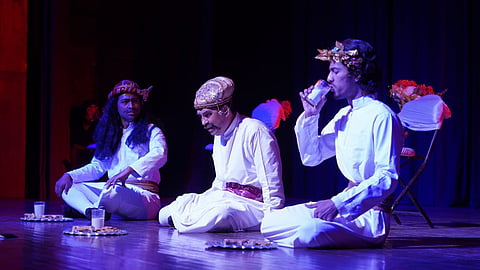
On the other side of town, a theatre troupe prepares itself for a tragedy. Their months of preparation will be watched by a few hundred people if they are lucky. This contrast underscores a shift in India’s cultural landscape; the slow demise of theatre and stage drama and the rise of stand-up comedy as the preferred entertainment for a new generation.
Veteran practitioner Sayeed Alam of Pierrot's Troupe notes that theatre in India , was never a mass medium."After the advent of cinema, theatre was seen more as an avenue to hone your skills before entering into the world of cinema and has moved at a slower pace and had its niche audience," he says.Today, professional theatre is mainly concentrated today in three cities – Delhi, Mumbai, Bengaluru – with minimal presence elsewhere.
An impatient audience
Sunit Tandon, president of the Delhi Music Society and a practitioner since 1977, identifies shrinking attention spans as one of the primary reasons for this change. Productions that once ran two and a half hours, now run for ninety minutes. The audience hasn't just got smaller they have grown more impatient.
The shift towards stand-up began roughly a decade ago, coinciding with YouTube, social media, and informal urban venues.
Today, comedy accounts for roughly a third of India’s 90,000 live events annually, with audience sizes growing from small rooms of 50 people to auditoriums hosting thousands within just a few years, according to an article in the Business Standard.
The stand-up comedy circuit in India witnessed a steady growth between 2010 to 2017, before exploding during the pandemic period, according to stand-up comedian Priyam Pandey.”Today at least 10-15 comedians in Delhi can sell out shows”, a marked shift from earlier years when only a handful of comedians could draw such crowds
Costs of theatre
But Alam says the audiences have shifted “due to accessibility not merit”. Stand-ups can be performed anywhere: a mall, a park, a hotel lobby.Whereas theatre needs a stage, lighting, costumes, props and a full cast.
The economics are equally stark. Even a houseful show of 350 people once netted Alam only ₹50,000 after spending ₹75,000 on rent, props, and artist fees. Theatre is the costliest form of entertainment as each performance demands fresh expenditure.
Dilip Gupta, a Delhi-based practitioner who works with Shri Ram Centre for Performing Arts, brings in the perspective of censorship."Increased government surveillance is curbing our freedom in exploring and performing serious dramas that question authority," he says."Comedy then becomes a safer avenue."It is a sobering admission — socio-political dramas and tragedy, traditionally the genres that question power, are being sidelined not only due to changing tastes but also due to political pressure, which has existed in some form.
Yet comic theatre practitioners are not despairing. Alam points to a unique advantage comedy holds over every other form: the ability to absorb the present. His play Akbar the Great Nahin Rahe has completed 650 performances. The reason, he explains, is that comedy can be updated continuously, weaving in current events and fresh absurdities. "You can infuse the latest geopolitical events and make a mockery of it," he says. "You cannot do that in a tragedy without distorting its structure. That flexibility exists only in comedy."
Tandon remains unfazed. He compares theatre to a full course meal - slow and satisfying, and stand-up as fast food, quick,appealing but lacking the same depth of satisfaction.
"Audiences will show up for comedy, drama, tragedy," he says, "Theatre, while it goes through its ups and downs, will never die."
Theatre’s staying power
In Triveni Kala Sangam located at Mandi House, people are seen practising. Aryan Mehta, 22, a theatre student, did not grow up on plays."Honestly, I grew up watching AIB and Zakir Khan on YouTube, that was my thing.I came here because one of my teachers in school took us to a play.But that first play I saw here, I don't know, it was different.It just sat with me.Can't really explain it.With stand-up, you laugh and forget, this was something else."
While theatre practitioners are performing at smaller venues, cutting production costs, and are adopting social media to market themselves .Gupta notes a quiet resurgence among today's youth, "fascinated by the various facets of drama".
Mehta’s classmate Priya Nair, 24, is more reflective."There's something visceral about sitting in a dark room and watching actual people go through raw unfiltered emotions in front of you; it hits differently.My parents thought theatre was a waste of time. But I think people our age just don't know this world exists.We can either crib about it or look for it.”
