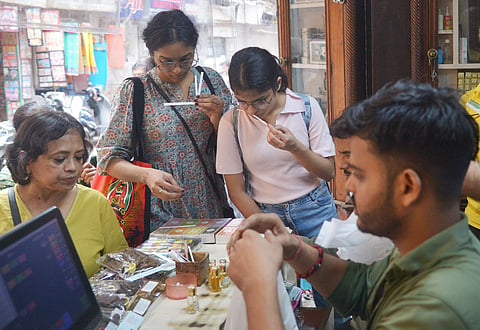

Established in 1816 by Lala Gulab Singh, Gulabsingh Johrimal in Dariba Kalan, is among the most recognisable names in Old Delhi. This is one of the city’s oldest surviving perfume houses and is, so goes the lore, standing from the time of the last Mughal, Bahadur Shah Zafar. The shop in Meena Bazaar is now run by its fifth generation, a Stephanian, along with his father and uncles.
Kushal Singh says it is a business that runs on passion, memory and most importantly, the nose. “Every scent can be created, recreated and customised. It's all in the notes of the scent; customers often ask for variations and recreations of luxury brands like Chanel and Dior, among others—we take a look at the notes and customise a similar fragrance,” he adds.
The legacy lives on
In a city where fashion is fickle and trends—including in deos and perfumes—come and go, a beloved attar lives on forever. Kushal knows this and respects his customers’ obsessions. Understanding notes, compositions, distillation and the way oils react with skin, heat and time is part of his everyday life now for the past 10 years. Every fragrance that has passed his hands is etched in his memory, he claims.

The Singhs sell floral and earthy attars distilled from rose, jasmine, vetiver, roots and herbs. They source them from Kannauj, the attar capital of India, near Lucknow. Kushal says Delhi's pollution is one of the factors why a setup to make attar can’t be built here. “If we do it in the city, the purity of the smell will be altered,” he says.
Over the years he has noticed a change in his customer base. What was once essentially a choice of the older generations has revived in recent years with the youth opting for attars as an everyday choice.
In the last two-three years, customers of every age have flooded the shop. “There are some who want 'unique scents' – they may say that 'we like rose and the woody smell so please combine it' - -while some opt for replication of the luxury brands,” he says.
Fierce competition
What’s the best-selling attar at present? Shamam, made of rose, is a hit even today. Opening a treasure-like storage box, Singh says that his ancestors were a regular to the court of the last Mughal emperor.
The attars still connect generations. For him, the shop is an archive of memory, skill and identity, one that has survived changing tastes, the decline of old bazaars, and the rise of modern perfume culture.
The competition for a perfect fragrance has grown fierce over time. Another shop near Filmistan cinema, Chachaji Attar Wale, established in 1928, is run by Akram. They have been running the business “for 250 years” with roots in Kannauj. He said that while the older generations opt for sandalwood, saffron and rose fragrances, the GenZs want replication of Gucci and Armani scents.
With monsoon at the door, Gill or mitti ka attar sells the most. At the same time, premium oud oils and artisanal blends have opened up a more aspirational segment, especially among younger consumers who see fragrance as a form of identity and self-styling.
An act of love
Paricher Tavaria, a fashion communication teacher who recently moved to Mumbai, says that her golden oud attar reminds her of her mother. “One of my young writers from my Delhi team actually gifted it to me. Every time I use it, I remember how my mother would open her cupboard and dab a bit on her wrist and then mine. This is an emotion, a memory, and part of my lifestyle now,” she says.
Talking about the renewed interest in oud and attar as a fashion choice, Tavaria says that “people have a greater desire to interact with goods/products that have meaning or significance, rather than just meaningless consumption today. When I rub a drop of attar on my wrist, I like to think of it as infusing myself with history and memory. Certain scents are windows through time. So attars for me have an inherited authenticity, as opposed to a constructed one.”
Growing up as a Parsi child between Dubai, Manchester, and India, attar has always been a part of her family across generations, and she takes it forward in tiny vials.
Products crafted with time, skill and tradition sit at the heart of the slow luxury movement. And right now, attars are a perfect expression of luxury, history and culture. Diya, a 23-year-old PR professional, says that the switch to attars was due to her love for history.
From the lanes of Jama Masjid’s Matia Mahal to finding a woody scent in Kashmir, she is turned into a connoisseur. “Unlike alcohol-based perfumes that disperse quickly into a room, attar is long-lasting and stays close to the body,” she says.
For some, attar is a lifestyle choice, while some wear it as a memory—as a lover’s first gift, a childhood nostalgia, a feeling they want to hold tighter. And perhaps that is why Delhi’s attar markets still matter. The fragrance reminds us of things that are more than just a trend—it is touch, conversation and inheritance.