
At a time when the present, captured in images, can be erased with a swipe and can vanish within seconds, ‘Paper and Play’ at Delhi’s Gallery XXL brings back the slower, tactile experience of viewing art on paper. Featuring prints, zines, paper weavings, digital works and experimental practices, the exhibition explores how a simple sheet of paper can become a space for conversations about identity, politics, memory and everyday life.
Co-curated by Priyanshi S, Giulia Ambrogi and Sarah Malik, the exhibition is on view till August 22.
According to Malik, the exhibition began with the idea of showing works inspired by urban contemporary and street art practices using paper — a material that is affordable and familiar.
"Paper is an accessible material both for artists and younger collectors," she says, adding that the paper has also historically been important for street art and public discourse, whether through posters, political campaigns or independent publishing.
The exhibition extends beyond artworks to include books, zines, games, and toys, creating what Malik describes as "an entry point" for audiences who may be unfamiliar with how art can be “contemporary” and speak to today’s times. The gallery has also introduced weekly drops of new prints, books, zines and objects, ensuring that the three-month exhibition continues to evolve.

Resistance in print
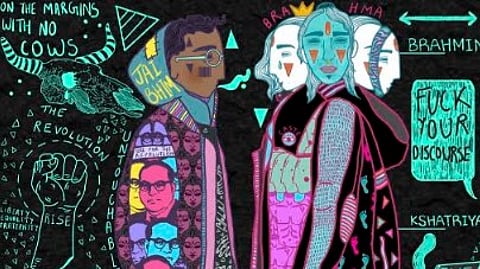
Multidisciplinary artist Priyanka Paul’s works explore social justice and self-reflection. In one of their works, ‘From the Margins’, the fierce confrontation between India's different caste groups is depicted in a face-off against a dark, graffiti-covered wall. On the left, a person wears a "Jai Bhim" hoodie embossed with stylised faces of Dr BR Ambedkar, and holds his book Annihilation of Caste.
On the right, a four-faced figure resembling Brahma, stands for the four castes; this figure holds the Manusmriti, a text associated with enforcing caste hierarchy and the subjugation of women. The artist says digital art appealed to them because of its ability to travel effortlessly across platforms.
"It offers the ability to be exchanged and shared so easily, from one screen to another, at the click of a button," Paul says, adding that the medium challenges exclusivity within the art world because it can be reproduced, reused and communicated widely.
Paul believes exhibitions such as ‘Paper and Play’ play an important role in expanding audiences for print-based practices. "Shows like this introduce new spaces and audiences to the craft of meaning-making through print.”
Posters of protest
Socio-political themes also run through the work of US-based Bangladeshi artist Debashish Chakrabarty, whose series ‘Rastro-Jontrona’ (state oppression in Bangla) borrows visual language from political posters, cinema hoardings, matchbox labels, and advertisements.
Originally trained as a photographer, Chakrabarty shifted to drawing and printmaking as he wanted his work to engage more directly with the political realities surrounding him.
"My earlier practice was oriented towards light and form," he says. "But gradually I wanted to reflect on the political forces that shape everyday life." Rather than producing works that resemble conventional gallery art, Chakrabarty intentionally adopts familiar visual formats.
"A commuter may not stop to look at an artwork, but they will glance at something that resembles a poster or a matchbox label," he explains. His work, he says, investigates how power operates through bureaucracy, surveillance, institutions and culture.
In 'Free Thinker’, Chakrabarty uses bright yellow and red colours with pictures of the famous Rodin’s ‘The Thinker’ stat, seemingly making a point about how society values intellectual work. It appears to play on the idea of a "Free Thinker" by pointing out they are actually getting "PAID $0 PER HOUR." The second artwork looks like an old-fashioned matchbox label with a picture of a flame over waves. It uses dark humour to talk about global warming, using fake sales slogans to say that "Heat" is a quality product that is "Scorching the Planet Democratically".
Breaking mental loops
Another interesting work is Vadodara-based sculptor and multidisciplinary artist Purvi Sharma’s woven-paper compositions, inspired by the repetitive loops of thoughts people often find themselves trapped in. "Everyone is stuck somewhere in their own belief systems," she says. "Through paper weaving, I wanted to show those patterns and then break them."
One of her works, ‘Cleaning the Wall’, a grid-style paper collage, explores the tension between cleanliness and grime by interweaving paper strips from a detergent advertisement with prints of a photograph depicting posters stuck on a dirty wall. Sharma explains that the idea for this work is inspired by observing the contradiction between cleanliness advertisements pasted on walls and the neglected public spaces surrounding them.
For Sharma, the process of weaving mirrors personal growth. "Art has helped me understand myself first," she tells TMS. "Like weaving, we constantly learn, unlearn and rebuild."
Visual artist Siddhartha Gohil, known as KHATRA, also from Vadodara, explores the intersection of typography, graffiti and urban culture. The pieces from his Fire Extinguisher series use retroreflective vinyl—a material commonly found on street signs, traffic signals and vehicles—along with spray paint and paint markers.
"I'm interested in how letterforms can function as visual art while reflecting the culture and energy of urban spaces," he says. "Every letter has its own rhythm, structure and personality. I'm interested in exploring the space where typography shifts from being something we read to something we experience as an image," he adds.
Stories on paper
Alongside these artists, ‘Paper and Play’ also features works by Ashna Malik, Beer Pitch (Pitchaya Satapornvajana), German duo Christoph Florin and several others, each bringing a distinct perspective to the exhibition. From optical illusions and abstractions to typography, graffiti-inspired visuals and experimental printmaking, their works show the breadth of contemporary paper-based practices.
Malik says the response has exceeded expectations. She says that even younger visitors, who are surrounded by digital media, seem to be looking for a space where they can slow down. Paper, she says, enables that pause by allowing people to read, reflect and engage with life.