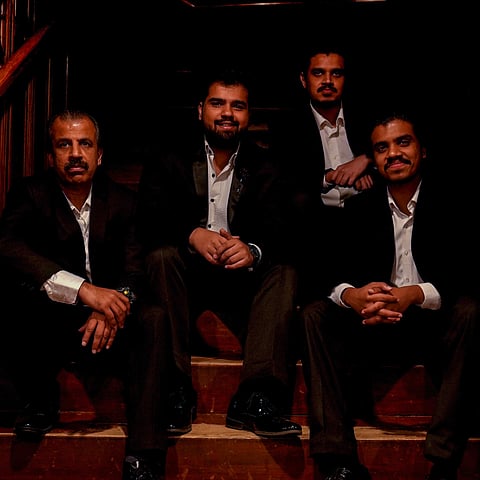

It was raining hard at the Motorama motorcycle festival when GAP Theory decided not to stop. Most bands would have walked off. Equipment at risk, crowd thinning, organisers nervous. But Menino Dias, 63, the band's lead guitarist, patriarch, and four-decade veteran of the Delhi live circuit, looked at his sons and kept playing. "Every show has its moments," Joel Dias, the band's keyboardist, says later. "That one had more than most."
GAP Theory is a Delhi band with a Goan soul, forged through family ties, a bond formed after living under the same roof for years. Menino is the father. Joel Dias, 26, plays the keyboard. Jonathan Dias, the younger brother, 23, holds down the bass. Harsh Bhardwaj, Joel's best friend since school, close enough to be family is the lead singer. The name, Joel says, means exactly that. Family. "In a very Vin Diesel kind of way."
Music in the family
The band formed in 2022, but the story starts much earlier. Menino left Goa in the late 1980s. Already a working musician, he planted himself in Delhi's commercial music scene at a time when live performance meant hotels, college festivals, late nights in clubs, and grinding out hundreds of shows a year. He played in bands called Black Slate and Jeremiah 2911. He built a reputation. He also built a household where music wasn't a hobby, it was the atmosphere.
"My sons grew up hearing rehearsals, seeing instruments everywhere," Menino says. "I didn't teach them. They just absorbed it." Joel and Jonathan were both playing seriously by their early teens. Joel had already done a stint in a school band with Bhardwaj before the pandemic broke that up. When COVID-19 disrupted Menino's own band - several members drifting back to Goa - he didn't go looking for replacements. He knocked on his sons' doors instead.
"It wasn't much of a conversation," Joel says. "We naturally flowed into it." That ease is visible on stage in ways that take other bands years to develop. GAP Theory communicates mid-set through eye contact and hand signals, rerouting songs without a word, responding to each other the way people do when they've shared a dining table for 20 years. There are no egos negotiating. There is just the music. And there is a lot of it.
What they play
The band's repertoire runs from 1960s swing to contemporary chart hits, taking in rock, jazz, Hindi film music and pop along the way. On any given night they might open with Stevie Wonder, pivot through Bill Withers, land on Californication, then detonate a techno song no one saw coming. The crowd almost never expects them. That's the point.
"People don't come to hear a jukebox," Joel says. "We want them to feel like something is happening, that the show is alive." Rather than a fixed playlist, GAP Theory tests the room with a handful of songs to gauge the audience’s reaction. Older crowd singing along to the first few bars? Push into the classics. A younger crowd? Move to the early 2000s and the lastest pop hit. "Summer of '69" almost always works. They have an arrangement for it that Joel describes simply as "a good one."
The Delhi audience
The Goan thread running through the band is harder to hear than to feel. Goa's music culture was shaped by centuries of Portuguese rule—a legacy of Latin rhythms, Konkani folk, and a coastal looseness that never quite made it to the mainland.
Delhi, by contrast, runs on Hindi pop and Bollywood. Menino has spent 35 years playing to Delhi audiences, and he says the gap has never fully closed. "The love for music in Goa is different. It's in the walls. Here you have to earn it every time." GAP Theory, in his telling, is partly an attempt to bring that earthy, eclectic Goan warmth into rooms that don't always expect it.
That philosophy was tested at Motorama, . When the rain came down, GAP Theory played harder. The crowd – mostly bikers – stayed. "It was wholesome," Joel says, and laughs a little at the word. For the band finishing the show and entertaining is a given, regardless of the external factors.
Nearly four decades in, Menino still practises for hours on some days. He says the industry has changed beyond recognition; streaming has made inroads into the live scene, television pulled audiences indoors, attention spans have shortened. But he doesn't sound particularly troubled by any of it. "The connection between a band and an audience," he says, "that part doesn't change. That's still the whole thing."
As GAP Theory played its latest show on Saturday at the Piano Man, there was, as always, no setlist. Menino plugged in. Joel found the right opening. Harsh read the room. Jonathan held the bottom end steady. And somewhere in the first few songs, the band figured out exactly who came tonight and delivered an unforgettable experience.
