
On a cold January night in 2014, Shaitan Singh Bishnoi, 35, in Naneu village in Rajasthan, stepped out into the dark after hearing gunfire to protect a wild animal he feared had been targeted. He and other villagers gave chase to poachers across the fields. The confrontation ended with Singh being shot at point-blank range. He was declared dead on arrival at the hospital.
He is one among many “Bishnoi martyrs”, author Anu Lall describes in her book, Bishnois and the Blackbuck: Can Dharma Save the Environment? (Vitasta Publishing). Here, the martyrs are ordinary people who risked, and often lost, their lives to protect animals and trees. Lall remembers her father, BR Lall, an Indian Police Service officer, telling her about Bishnois pursuing poachers and taking them to the police station, sometimes with support from entire villages.
The book explores the relationship between faith and conservation of nature in the Bishnoi community. “For a lot of us, the introduction to the Bishnoi community unfortunately happened with the Salman Khan blackbuck case,” Lall says referring to the 1998 case involving alleged hunting of two blackbuck and three chinkara. The other accused in the case — Saif Ali Khan, Sonali Bendre, Tabu, and Neelam Kothari were later acquitted due to a lack of evidence.
However, Lall says that this is not all there is to the community’s story. She wanted to understand how and why they stand up so fiercely for animals and trees. This led her to research the issue for about two-and-a-half-years during which she studied court records to know more about the long-running legal battle around blackbuck poaching, and travelled across Rajasthan, meeting community members, conservationists, and researchers.

Principles to live by
The Bishnois, who primarily live in Rajasthan, Punjab, and Haryana, follow a 550-year-old philosophy laid down by spiritual leader Guru Jambheshwar — founder of the Bishnoi Panth, a set of 29 principles followed by the community. “The community’s ethos revolves around protecting all wildlife, especially blackbucks, who are seen as delicate animals that deserve protection,” the author writes in her book.
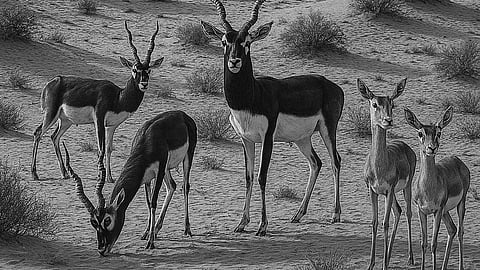
Blackbucks were once widespread across the Indian subcontinent but are now largely confined to protected areas due to habitat loss and hunting. The species is listed under Schedule I of the Wildlife Protection Act, 1972, granting it the highest level of legal protection in India. Describing the animal, Lall writes, “This graceful creature… moves with a speed and stride that is almost poetic,” capable of reaching up to 80 kmph.
Bishnois consider it their “dharma” or duty to protect the animal, as well as the other flora and fauna. In the book, Lall also cites Article 51A(g) of the Indian Constitution, which states that it is a citizen’s fundamental duty “to protect and improve the natural environment, including forests, lakes, rivers and wildlife, and to have compassion for living creatures.”
One of the chapters recounts another incident: In 1996, Nihal Chand Bishnoi confronted hunters to save blackbucks and lost his life. He was later awarded the Shaurya Chakra posthumously. His father, speaking in a documentary, said, “I mourn my son, but I am happy he became a shaheed while protecting our Bishnoi faith.”
The ecology of belief
Lall argues that many traditional Indian practices once carried this ecological wisdom, though much of it has been lost or reduced to ritual. In contrast, the Bishnoi way of life continues to integrate conservation into everyday practices. They protect trees and feed wildlife. For instance, when young fawns are orphaned due to poaching, accidents, or natural causes, Bishnoi women breast-feed them milk, “caring for them like their own children.”
Mostly living in the arid regions of Rajasthan, where resources are scarce, the community has learned to survive with little, but they cherish and guard that.
The book suggests that such community-driven models could offer valuable lessons for modern conservation efforts. While policies and laws remain important, Lall believes they need to be complemented by grassroots action. “Community-based conservation creates moral authority,” she says. “It is collective, it is rooted, and it is sustainable.”
Across India, similar traditions exist in the form of sacred groves —patches of forest protected by local communities due to religious beliefs. Known as orans in Rajasthan and devbans in Uttarakhand, these places have functioned as informal conservation zones for long.